How Your Home Gets Its Power
Electricity arrives at your home from a utility company through overhead or underground wires called a service line. That line connects to a meter mounted on the outside of your home - the device your utility company reads to calculate your bill. From the meter, power travels inside to your main electrical panel.
Most U.S. homes receive what is called 120/240-volt single-phase service. In plain terms, this means you have access to both standard 120-volt power (used by lights, small appliances, and most outlets) and 240-volt power (used by large appliances like electric dryers, ranges, and central air conditioners).
Understanding this basic flow - utility line → meter → panel → circuits → outlets - gives you a mental map for troubleshooting and talking to professionals. As part of your overall home care routine, knowing the electrical system fits neatly into the broader picture covered in our room-by-room home maintenance schedule.
Circuit
A closed loop of wiring that carries electricity from the panel to outlets or fixtures and back again. Each circuit is protected by its own breaker.
Circuit breaker
A safety switch inside your electrical panel that automatically shuts off power to a circuit when it detects too much current flowing through it.
GFCI outlet
A special outlet that monitors electrical current and cuts power almost instantly if it detects a ground fault - a situation that could cause electric shock. Required near water sources by U.S. electrical codes.
Amperage (amps)
A measure of how much electrical current flows through a wire or circuit. Higher-amp circuits can power larger, more demanding appliances safely.
Service panel
The main metal box (also called a breaker box or load center) where your home's electrical supply is distributed to individual circuits throughout the house.
Ground wire
A safety wire in modern electrical systems that provides a path for stray current to travel safely to the earth rather than through a person.
The Electrical Panel Explained
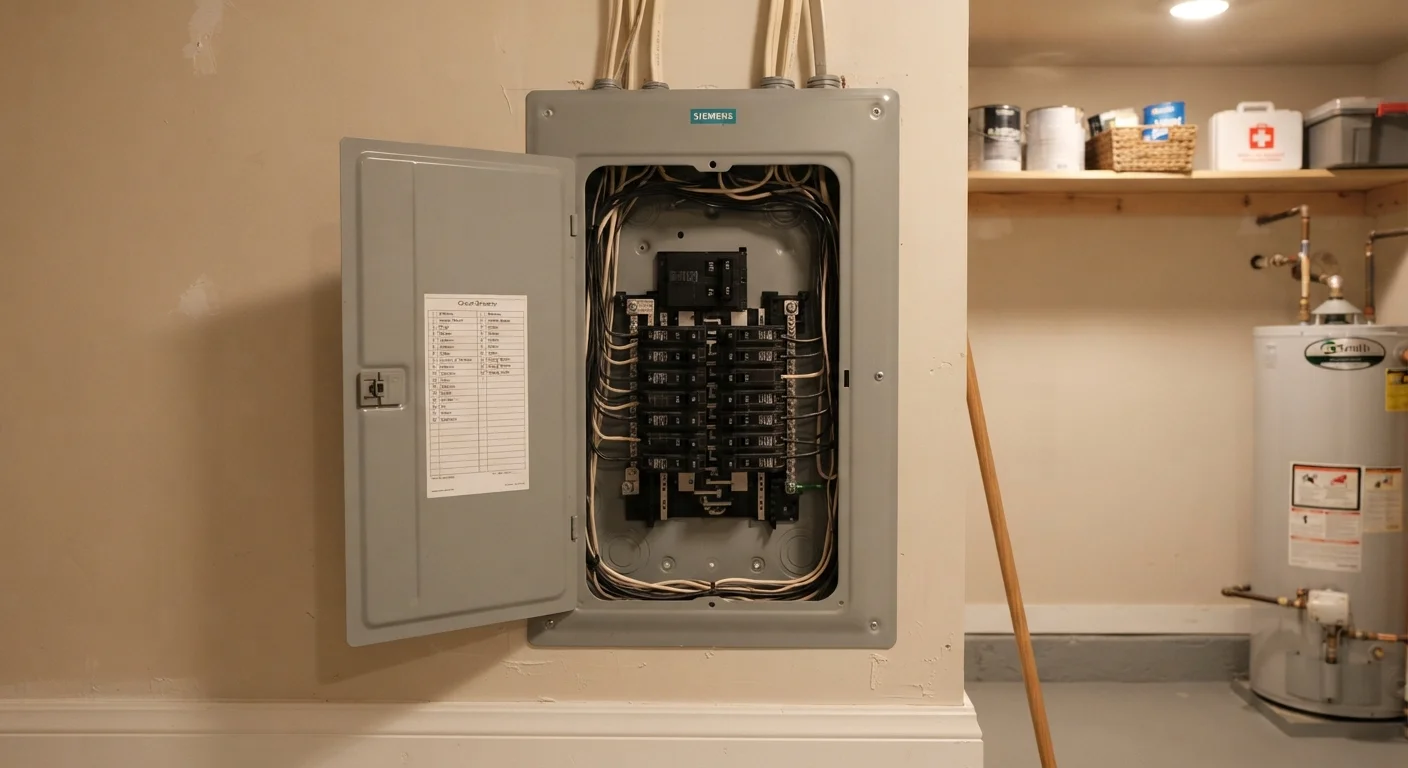
Your electrical panel - sometimes called the breaker box or load center - is typically a metal cabinet mounted in a utility room, basement, hallway, or garage. Inside, you will find:
- Main breaker: A large double-pole switch at the top that controls power to the entire panel. Flipping it off cuts electricity to the whole house.
- Individual circuit breakers: Smaller switches, each controlling a separate circuit in your home. They are labeled (or should be) to indicate which rooms or appliances they serve.
- Amperage rating: The main breaker's label shows the panel's total capacity - commonly 100A, 150A, or 200A. Older homes may have lower-capacity panels that struggle with modern electrical demands.
When a circuit draws more current than its breaker allows, the breaker trips - it flips to a middle or OFF position automatically. This is a safety feature, not a malfunction. Resetting it is straightforward: switch it fully to OFF, then back to ON. If it trips repeatedly, that is a sign of a deeper issue requiring professional assessment.
Label Your Breakers Now
If your breaker panel is poorly labeled, take 20 minutes to map it out. Plug a lamp into each outlet, then flip breakers one at a time and note which lamp goes out. Use adhesive labels or the panel's built-in directory card to record each circuit's location. Clear labels make future troubleshooting dramatically faster and safer.
Outlets, Switches, and Circuits
Every outlet and light fixture in your home belongs to a circuit - a continuous loop of wiring that carries electricity from the panel and back. Circuits are rated in amps (typically 15A or 20A for standard rooms) and are designed to serve a specific load.
Two outlet types deserve special attention:
- GFCI outlets (Ground Fault Circuit Interrupter): Recognizable by their TEST and RESET buttons, these protect against electric shock near water sources. U.S. electrical codes require them in bathrooms, kitchens, garages, and outdoors.
- AFCI outlets and breakers (Arc Fault Circuit Interrupter): These detect dangerous arcing - electrical sparks inside walls - and are now required by code in most living areas in newer construction.
A single GFCI outlet can protect other outlets downstream on the same circuit. If an outlet in your bathroom stops working, check whether a GFCI outlet nearby has a tripped RESET button before assuming the worst.
Switches simply interrupt the hot wire in a circuit to turn lights or fans on and off. Three-way switches - which control one fixture from two locations, like at both ends of a staircase - involve slightly more complex wiring.
Common Electrical Problems and What They Mean
Most homeowners encounter a handful of recurring issues. Here is what they typically signal:
- Tripping breaker
- Usually indicates a circuit is overloaded. Unplug some devices and reset. Frequent tripping on the same circuit warrants an electrician's review.
- Dead outlet
- Check the panel for a tripped breaker first, then look for a tripped GFCI outlet on the same circuit. If neither applies, the outlet itself may be faulty.
- Flickering lights
- Occasional flickering when a large appliance starts is normal. Persistent or widespread flickering can indicate a loose connection or a utility service issue - both need professional attention.
- Warm outlets or a burning smell
- These are serious warning signs. Stop using the outlet immediately, turn off the circuit at the panel, and call a licensed electrician without delay.
Before starting any hands-on investigation, always review pre-project safety steps to make sure your workspace is safe.
Never Ignore These Warning Signs
A burning smell, discolored outlets, or outlets that feel warm to the touch are potential signs of overheating wiring - a leading cause of house fires. Do not simply reset the breaker and move on. Turn off the circuit at the panel and contact a licensed electrician before using that circuit again.
When to DIY and When to Call a Licensed Electrician
Electrical work sits on a clear spectrum from safe-for-homeowners to strictly-for-professionals. Here is a practical breakdown:
| Task | Who Should Do It |
|---|---|
| Resetting a tripped breaker | Homeowner |
| Pressing RESET on a GFCI outlet | Homeowner |
| Replacing an outlet cover plate | Homeowner |
| Replacing a standard outlet or switch (like-for-like) | Confident DIYer - check local permit rules |
| Installing new circuits or wiring | Licensed electrician |
| Upgrading or replacing the electrical panel | Licensed electrician |
| Any work inside the panel beyond resetting breakers | Licensed electrician |
When in doubt, the cost of a professional visit is far less than the cost of a fire or injury. Our broader guide on where DIY makes sense and where it doesn't can help you calibrate that decision across every type of home project.
Finally, always verify local permit requirements before any electrical work. Many jurisdictions require permits for work beyond simple replacements, and unpermitted electrical work can complicate home insurance claims and future property sales.
This article is for general informational and educational purposes only. It is not a substitute for advice from a licensed electrician. Electrical work involves serious risk of injury, fire, and property damage. Always consult a qualified professional for work beyond basic tasks, and verify local code and permit requirements before beginning any project.