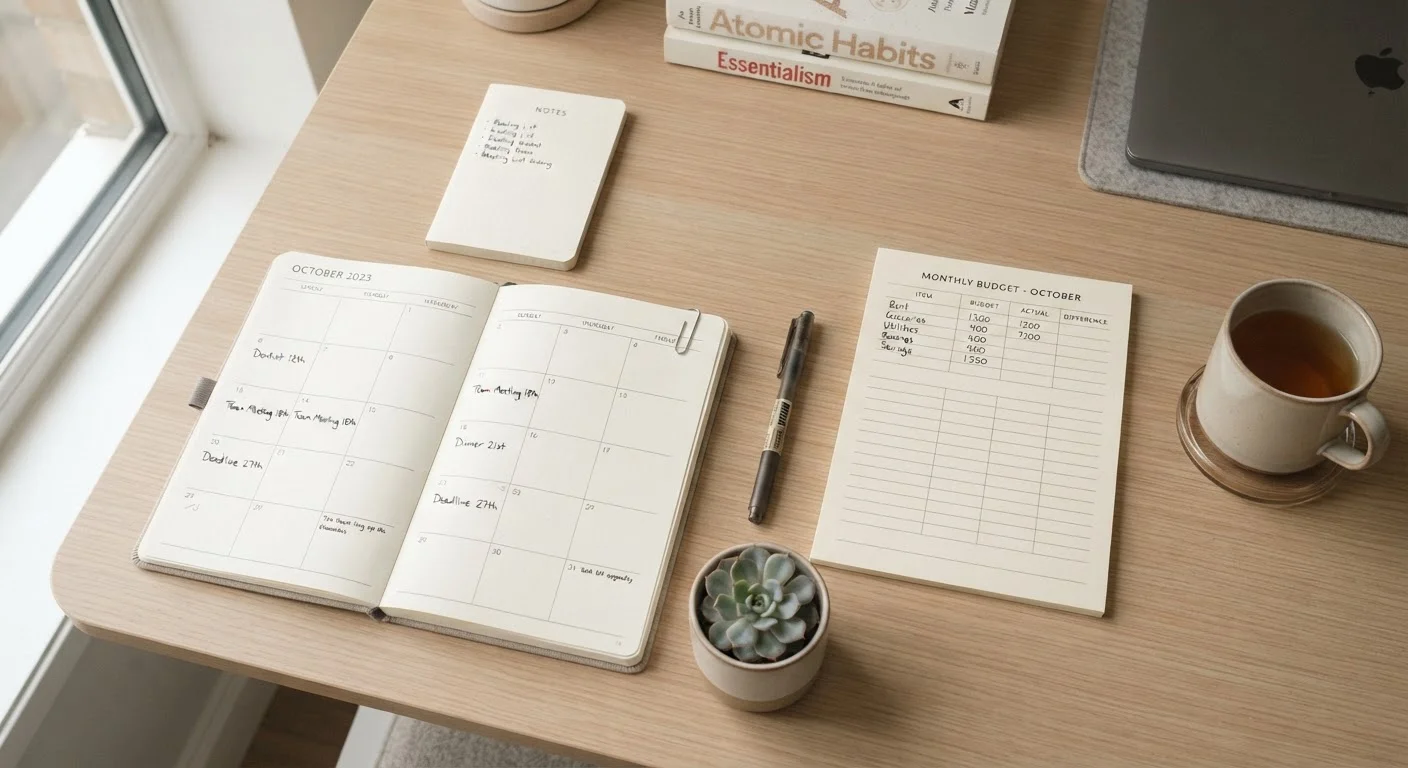

How Your Brain Turns Behaviour Into Routine
Every habit you have - from brushing your teeth to reaching for your phone in the morning - once required deliberate effort. Over time, repetition shifted those actions into a kind of mental autopilot. Understanding why this happens is the first step to harnessing it intentionally.
When you repeat a behaviour in a consistent context, your brain begins to bundle that sequence of actions into an efficient neural shortcut. The basal ganglia - a deep brain structure involved in movement and procedural learning - plays a central role in this process. As a behaviour becomes more practised, the brain essentially "chunks" it, requiring less conscious attention each time. This frees up cognitive resources for other tasks.
The key insight here: habit formation is not about motivation - it's about repetition in context. Motivation gets you started, but the environment and consistency are what make a behaviour stick.
The "21-Day Myth" Explained
You may have heard that it takes 21 days to form a habit. This figure has been widely repeated but is not supported by scientific research. It originated from a plastic surgeon's informal observations in the 1960s and was never a controlled study. Current evidence suggests the actual timeline is considerably longer and varies significantly between individuals and behaviours. Setting realistic expectations helps you stay consistent without feeling like something is wrong if a habit isn't automatic after three weeks.
The Cue-Routine-Reward Loop Explained
Researchers have described habit formation through a simple but powerful framework known as the habit loop, made up of three parts:
- Cue: A trigger - an event, time of day, emotion, or location - that prompts the behaviour.
- Routine: The behaviour itself, whether physical, mental, or emotional.
- Reward: A positive outcome that tells the brain this loop is worth repeating.
For example, the alarm going off (cue) prompts a five-minute stretch (routine) that leaves you feeling less stiff (reward). Each repetition of this loop strengthens the neural pathway, making the routine increasingly automatic.
The practical takeaway: to build a new habit, pair it with a reliable cue and make the reward immediate and noticeable. You're essentially programming your brain one repetition at a time.
66 days
Average time to form a new habit
According to a study by Lally et al. published in the European Journal of Social Psychology, the average time for a behaviour to become automatic was 66 days, ranging widely by individual and complexity.
40%
Of daily actions driven by habit
Research by Wendy Wood and colleagues at Duke University estimated that approximately 40% of everyday behaviours are habitual rather than consciously decided.
18-254 days
Range of habit formation timelines
The same UCL study found significant variation - some participants formed habits in under three weeks, while others needed more than eight months, underscoring that individual differences matter.
Why Starting Small Is the Most Evidence-Backed Approach
There's a common belief that meaningful change requires dramatic effort. The science disagrees. Research in behaviour change consistently shows that lowering the bar for entry - making a habit so small it feels almost too easy - produces more durable results than ambitious overhauls.
This approach works for a straightforward reason: when a habit is small, the friction to begin is minimal. You're less likely to negotiate your way out of it on a tired Wednesday evening. And each completed repetition, however brief, still reinforces the neural pathway associated with that behaviour.
Behavioural scientist BJ Fogg, whose research at Stanford focuses on behaviour design, has argued that making behaviours tiny is not a shortcut - it's the mechanism. Tiny habits, anchored to existing routines, compound into significant change over time.
Anchor New Habits to Existing Ones
One of the most effective strategies for building new habits is "habit stacking" - attaching a new behaviour to something you already do reliably. For example: "After I pour my morning coffee, I will write one sentence in my journal." The existing routine acts as a built-in cue, eliminating the need to remember or motivate yourself separately.
This principle extends well beyond wellness. The same logic applies to building financial routines - as explored in our guide to monthly financial habits that support credit health over time.
Consistency Over Intensity - and What Happens When You Slip
One of the most freeing findings from habit research is this: missing a single day does not undo your progress. A study by Phillippa Lally and colleagues at University College London found that occasional lapses had no meaningful impact on the long-term formation of a habit. What matters is returning to the routine as soon as possible.
Perfectionism is often the enemy of consistency. If you frame a missed session as a failure that invalidates your efforts, you're more likely to abandon the habit entirely. Instead, treat a slip as information - perhaps your cue wasn't reliable, or the routine was too demanding for that day.
Building habits that last also means anticipating obstacles. If your evening walk gets rained out, what's your backup? Planning for imperfect conditions in advance is one of the most practical things you can do to protect a new behaviour.
For a deeper look at why routines unravel - and how to spot the warning signs early - see our article on why healthy habits fall apart.
This article is for informational purposes only and is not a substitute for personalised advice from a qualified health professional. If you have concerns about your health or wellbeing, please speak with your doctor or a licensed healthcare provider.