
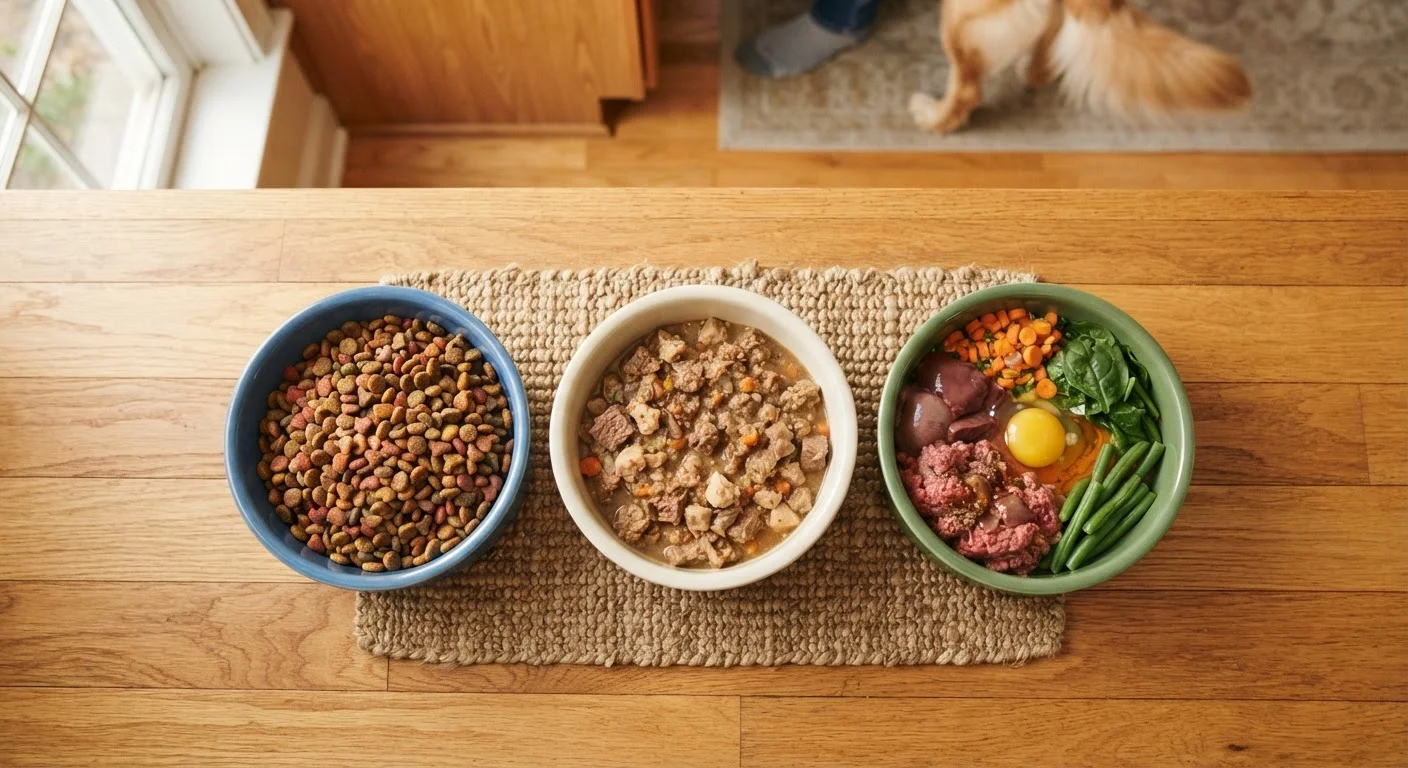
Why Dog Food Format Actually Matters
Walk into any pet store and the sheer number of feeding options can feel overwhelming. But the choice between dry, wet, and raw food isn't just about preference - format affects hydration, nutrient delivery, food safety, cost, and how much prep time you'll spend each day. Understanding what each format actually is helps you move past marketing language and make a decision grounded in your dog's real needs and your household's real capacity. For a broader look at how a dog's nutritional needs shift across puppyhood, adulthood, and senior years, see our guide to feeding dogs at every life stage.
Dry Food (Kibble): Convenient and Well-Studied
Dry kibble is the most widely used dog food format in the United States, and for practical reasons. It stores easily at room temperature, has a long shelf life, and is generally the most affordable option per serving. Nutritionally, commercial dry foods that carry an AAFCO (Association of American Feed Control Officials) statement of nutritional adequacy have been formulated to meet established standards for dogs at specific life stages.
One real limitation of dry food is moisture content - kibble typically contains only about 10% water, compared to a dog's natural prey diet which is much higher. Dogs that don't drink enough on their own can end up mildly under-hydrated over time. There's also ongoing debate about whether the high-heat processing involved in making kibble degrades some heat-sensitive nutrients, though reputable manufacturers account for this in their formulas.
Check for AAFCO Nutritional Adequacy
When evaluating any commercial dog food - dry or wet - look for the AAFCO nutritional adequacy statement on the label. This indicates the food has been formulated to meet established nutrient profiles for a specific life stage. It's one of the most reliable signals that a product meets a minimum nutritional standard, regardless of how appealing the packaging looks.
Kibble is a reasonable starting point for most healthy adult dogs, but not all kibbles are created equal. Look for an AAFCO nutritional adequacy statement on the label rather than relying on packaging claims alone.
Wet Food: Higher Moisture, Higher Cost
Canned or pouched wet food typically contains 70-80% moisture, making it a useful choice for dogs that don't drink much water, those with urinary tract issues, or seniors whose sense of thirst may be declining. The softer texture also benefits dogs with dental pain or missing teeth. Many owners find that dogs simply find wet food more appealing, which can be helpful for picky eaters or dogs recovering from illness.
The trade-off is cost - wet food generally costs more per calorie than dry, and opened cans must be refrigerated and used within a day or two. It also doesn't provide the mild mechanical abrasion that some believe dry kibble offers for dental health, though veterinary dentists note that regular tooth brushing is far more effective than food texture regardless of format. Some owners mix a small amount of wet food into dry kibble to increase palatability without dramatically raising the food budget.
Raw Feeding: Higher Effort, Genuine Risks
Raw diets - sometimes called BARF (Biologically Appropriate Raw Food) or prey-model diets - typically include uncooked muscle meat, organ meat, raw meaty bones, and sometimes fruit or vegetables. Proponents argue that this more closely mirrors what dogs evolved eating and that it can produce improvements in coat quality, digestion, and energy levels.
However, several major veterinary organizations, including the American Veterinary Medical Association (AVMA) and the American Animal Hospital Association (AAHA), have expressed concern about raw diets. The core issues are: food-safety risk from pathogens like Salmonella and Listeria (which can affect both dogs and the humans handling the food), and nutritional imbalance if the diet isn't carefully formulated. Homemade raw diets in particular frequently fall short of calcium, phosphorus, or specific vitamins unless deliberately planned, often with input from a board-certified veterinary nutritionist.
Raw Diets Carry Real Safety Responsibilities
Pathogens such as Salmonella and Listeria can be present in raw meat intended for dogs. These bacteria can contaminate surfaces, bowls, and hands - posing a risk to humans in the household, not just the dog. If anyone in your home is immunocompromised, pregnant, elderly, or a young child, discuss the risks explicitly with your veterinarian before starting a raw diet.
If raw feeding is something you want to explore, it's worth having a candid conversation with your veterinarian first - especially if there are young children, elderly individuals, or immunocompromised people in your home. The bacterial contamination risk is real and applies to surfaces and hands, not just the dog's bowl.
| Dry Food | Wet Food | Raw Food | |
|---|---|---|---|
| Average cost per day | Lower | Moderate to high | High (especially for large dogs) |
| Moisture content | ~10% | 70-80% | Varies; generally high |
| Preparation time | Minimal - scoop and serve | Low - open and serve | High - sourcing, portioning, safe handling |
| Storage ease | Easy; room temperature | Opened portions refrigerated | Frozen; strict handling required |
| Food safety concerns | Low | Low when used promptly | Higher - bacterial pathogen risk |
| Nutritional completeness | Well-regulated via AAFCO | Well-regulated via AAFCO | Requires careful formulation |
| Best suited for | Most healthy dogs | Seniors, picky eaters, low drinkers | Owners with time and resources to do it safely |
Making the Decision for Your Dog
There's no universally correct format. The right choice depends on your dog's age and health status, your budget, and how much time you can realistically dedicate to food prep and safe handling. A healthy, active adult dog can thrive on a complete and balanced kibble. A senior dog with kidney concerns may benefit from a higher-moisture wet food. A dog with specific allergies or digestive conditions may need a diet formulated under veterinary supervision, regardless of format.
Cost is also worth thinking through honestly. Feeding a large dog a raw diet can run significantly higher per month than kibble, and that difference compounds over a dog's lifetime. Our overview of what dog ownership really involves covers how food costs fit into the broader financial picture of keeping a dog.
Whatever format you choose, transition slowly - over 7 to 10 days - to avoid digestive upset, and monitor your dog's weight, energy, coat condition, and stool quality as indicators of how well the diet is working. If anything seems off, your veterinarian is the right first call.
This article is for general informational purposes only and is not a substitute for veterinary advice. Always consult a licensed veterinarian before making significant changes to your dog's diet, especially if your dog has an existing health condition.