
Why This Decision Matters
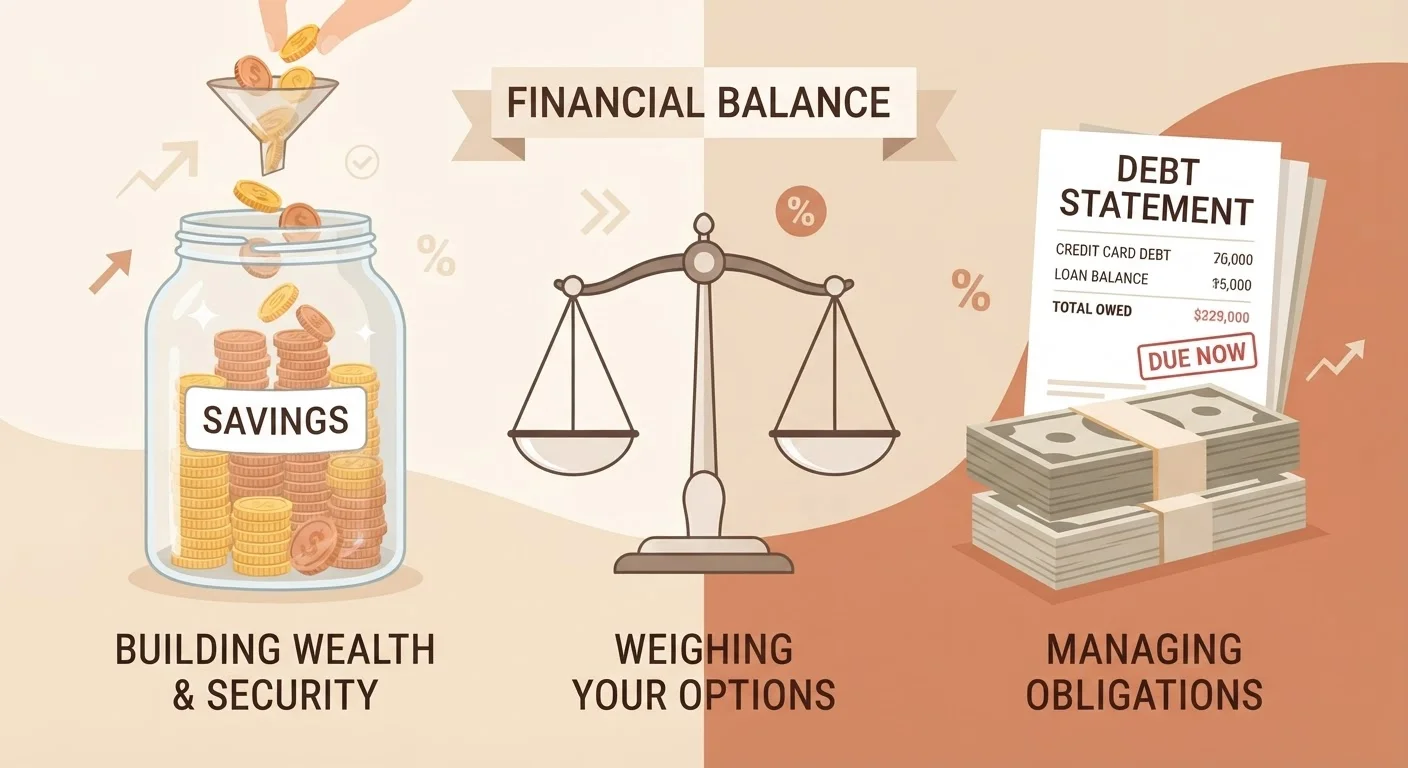
Most people have limited dollars left over after covering essential expenses. Deciding where those extra dollars go - toward savings or debt - shapes your financial security for years. Choosing poorly can mean paying thousands in unnecessary interest, or finding yourself in a bind when an unexpected expense hits.
This isn't a one-size-fits-all question. The answer hinges on a few key factors: the interest rate on your debt, whether you have any savings buffer, and your income stability. Understanding each piece helps you make a plan that actually works for your situation, rather than following generic rules that may not fit.
For broader context on building a budget that accommodates both goals, the Budgeting Basics hub offers practical frameworks to get started.
The Core Trade-Off: Interest Rate Math
At its heart, this is a math problem. If your debt carries a 20% annual interest rate - common for credit cards - every dollar you leave unpaid costs you 20 cents per year. A standard savings account earns far less. So mathematically, paying down high-interest debt delivers a guaranteed "return" equal to the interest rate you eliminate.
Low-interest debt changes the calculation. A 4% student loan or mortgage costs far less to carry, meaning money invested in a retirement account with potential long-term growth might outpace what you save in interest charges. That said, guaranteed savings from debt repayment carries no risk - investment returns are never certain.
| Pay Off Debt First | Build Savings First | Hybrid Approach | |
|---|---|---|---|
| Best interest rate scenario | High-interest debt (above 8-10%) | Low-interest debt (below 5%) | Mixed rates across multiple debts |
| Emergency resilience | Low until debt is cleared | High - fund grows steadily | Moderate - some buffer maintained |
| Guaranteed financial benefit | High - eliminates costly interest | Lower - savings earn modest rates | Moderate - balanced benefit |
| Psychological motivation | High for debt-averse individuals | High for security-focused individuals | Good for those needing visible progress |
| Risk of setback | Higher - no cushion for surprises | Lower - fund absorbs shocks | Lower - partial buffer maintained |
| Time to full financial stability | Faster debt freedom, then save | Slower debt payoff overall | Gradual progress on both fronts |
If you're weighing different debt repayment strategies once you've decided to tackle debt, the debt snowball and avalanche comparison breaks down two popular methods.
The Case for Building an Emergency Fund First
Here's a trap many people fall into: they pour every spare dollar into paying off a credit card, then a car repair wipes them out and they charge the card right back up. Without any savings cushion, unexpected costs send you straight back into debt.
Most personal finance educators suggest keeping a small emergency fund - commonly cited as $500 to $1,000 - even while aggressively paying down debt. This buffer handles minor emergencies without derailing your progress. Once high-interest debt is cleared, the recommendation generally shifts to building three to six months of essential expenses in savings.
Start With a Small Savings Target
Before funneling everything into debt, aim to set aside $500 to $1,000 in a separate savings account first. Even this modest cushion dramatically reduces the chance you'll need to reach for a credit card when something unexpected comes up. Once you hit that initial target, redirect your full extra dollars toward high-interest debt.
Common habits that quietly stall progress are covered in why good intentions stall debt repayment - worth a read if you've been making payments but not seeing results.
The One Exception: Employer Retirement Matches
If your employer offers a 401(k) match - say, matching 50 cents for every dollar you contribute up to 6% of your salary - that match represents an immediate 50% return on those dollars. No debt repayment strategy beats that. Financial educators broadly agree: contribute at least enough to capture the full employer match before directing extra money elsewhere.
Beyond the match, prioritizing additional retirement contributions over debt repayment becomes more debatable and depends on your specific interest rates and timeline. This is one area where consulting a licensed financial professional can help you model what makes sense for your numbers.
~40%
Americans who can't cover a $400 emergency
Federal Reserve surveys have consistently found that a large share of U.S. adults would struggle to cover an unexpected $400 expense without borrowing or selling something.
15-29%
Typical credit card APR range
Credit card annual percentage rates in the U.S. have historically ranged broadly; carrying a balance at these rates makes repayment a high financial priority for most households.
The Hybrid Approach: Doing Both at Once
For many people, a rigid "all debt, then all savings" plan feels psychologically unsustainable. Watching savings stay at zero for months - even while debt falls - can feel demoralizing. A hybrid approach splits extra dollars between both goals.
For example, someone with $200 of monthly discretionary income might direct $150 toward a high-interest credit card and $50 into savings. Progress on debt is slower, but savings grow steadily, reducing the risk of a setback. Once the card is paid off, the full $200 goes to savings or the next debt.
If your debt situation is complex - multiple loans at different rates - debt consolidation may simplify your payments and potentially reduce the interest you pay. And before taking on any new borrowing, review the pre-borrowing checklist to make sure you're ready.
This article is for general informational purposes only and does not constitute personalized financial advice. For guidance specific to your situation, consult a licensed financial professional.