
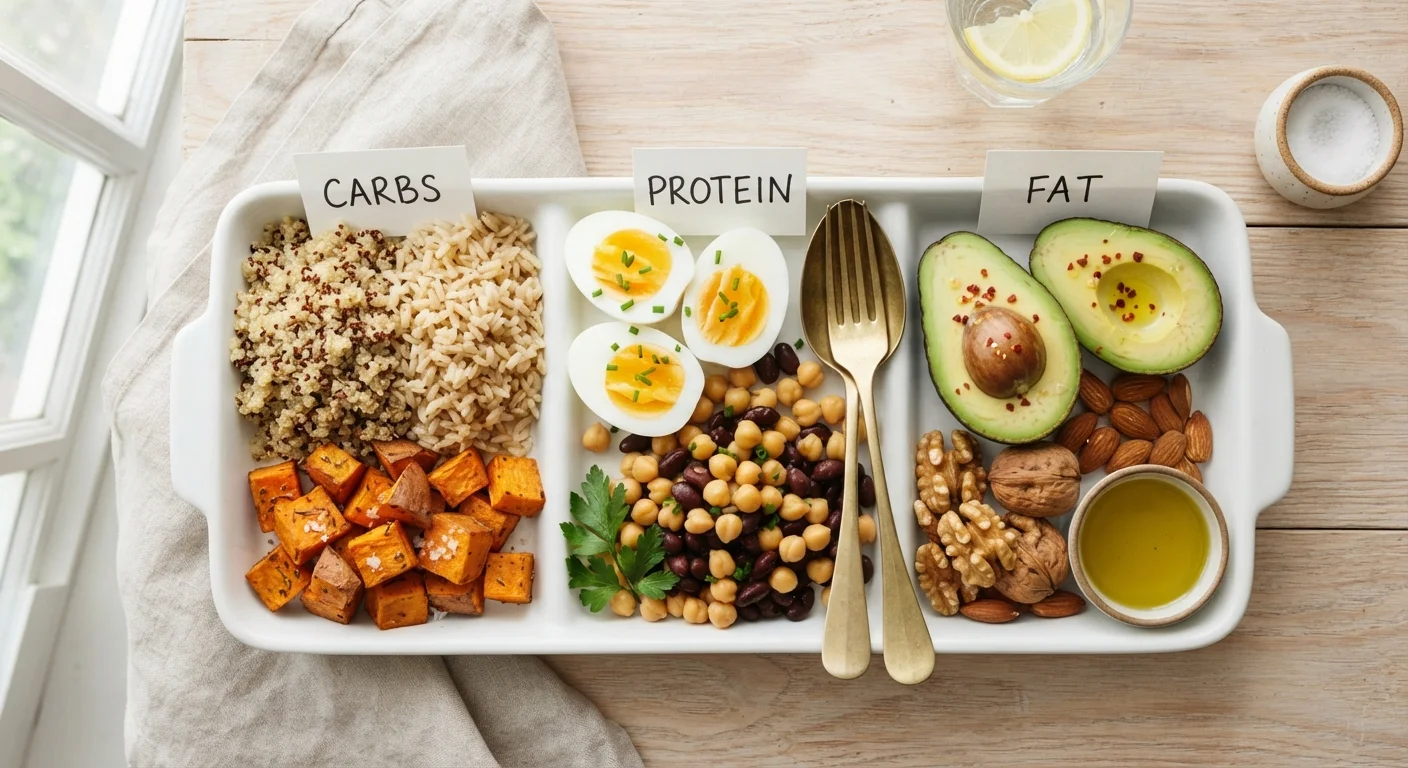
Why Macronutrients Matter
Walk through any grocery store and you'll see packaging shouting about protein content or warning about carbs. The noise can make eating feel complicated. But macronutrients themselves are simply the structural categories that all food energy comes from - and once you understand what each one does, a lot of that noise quiets down.
Think of macronutrients as your body's three-department supply chain. Each department handles different jobs, and your body runs best when all three are represented. You can learn more about how individual nutrients appear on food packaging in our guide to reading a nutrition label.
45-65%
Recommended share of calories from carbohydrates
According to the Dietary Guidelines for Americans, carbohydrates should make up roughly 45-65% of total daily calorie intake for most adults.
10-35%
Recommended calorie share from protein
The Dietary Guidelines for Americans recommend that protein account for 10-35% of daily calories, reflecting the wide variation in individual needs.
20-35%
Recommended calorie share from dietary fat
Mainstream dietary guidance places healthy fat intake at 20-35% of total calories, with an emphasis on unsaturated fat sources.
Carbohydrates: Your Body's First Choice for Fuel
Carbohydrates are broken down into glucose, which your cells - especially your brain and muscles - burn for energy. When you eat a meal containing carbs, your digestive system converts them to glucose that enters your bloodstream, powering everything from a morning walk to focused thinking at work.
Not all carbohydrates behave the same way. Complex carbohydrates - found in whole grains, legumes, vegetables, and fruits - are digested more slowly, providing steady energy and fiber that feeds beneficial gut bacteria. Simple carbohydrates - heavily refined sugars and processed starches - digest rapidly and can cause sharper spikes in blood sugar.
Fiber, technically a type of carbohydrate, deserves a special mention. It isn't digested for energy, but it plays a major role in digestive health, cholesterol regulation, and keeping you feeling full longer. Most Americans fall short of recommended fiber intake, according to dietary research.
Protein: Building, Repairing, and Running the Body
Protein is made of smaller units called amino acids - often described as the building blocks of life. Your body uses amino acids to build and repair muscle, produce enzymes that drive chemical reactions, make hormones that regulate everything from sleep to metabolism, and support immune function.
Of the 20 amino acids your body needs, nine are considered essential - meaning your body can't manufacture them and must get them from food. Complete proteins (found in animal products like meat, fish, eggs, and dairy) contain all nine essential amino acids. Many plant sources - such as beans, lentils, tofu, and quinoa - also provide protein, and eating a variety of plant proteins throughout the day can cover all essential amino acids.
Protein also contributes to satiety, the feeling of fullness after a meal, which is one reason protein-rich foods tend to be satisfying even in moderate portions.
Fat: Essential, Not the Enemy
Dietary fat has carried an unfair reputation for decades, largely driven by now-outdated research. In reality, fat is essential for life. Your body relies on fat to absorb vitamins A, D, E, and K (all fat-soluble), to build cell membranes, to produce hormones including estrogen and testosterone, and to cushion and protect vital organs.
The type of fat matters. Unsaturated fats - found in olive oil, avocados, nuts, seeds, and fatty fish - are broadly associated with cardiovascular health in research. Saturated fats, found in red meat and full-fat dairy, are fine in moderation for most people but warrant attention in large quantities according to mainstream dietary guidelines. Trans fats, which were industrially produced and added to many processed foods, have been largely removed from the US food supply due to demonstrated health risks.
Choose Fat Sources With Care
Swapping some saturated fat sources for unsaturated ones - such as using olive oil in place of butter or snacking on nuts instead of heavily processed chips - is a simple, practical shift supported by dietary research. You don't need to eliminate any fat; focusing on the type can make a meaningful difference over time.
Fat also slows digestion, which is part of why meals containing healthy fats tend to keep you satisfied for longer periods. For a deeper look at how different food qualities - beyond just calories - affect your body, see our article on food quality.
How the Three Work Together
Macronutrients don't operate in isolation. A meal that combines all three tends to be more satisfying, more nutritionally complete, and better at sustaining energy than a meal heavy in just one. Carbohydrates provide quick fuel; protein slows digestion and supports repair; fat extends satiety and enables vitamin absorption.
Popular diets often emphasize or restrict one macronutrient dramatically - and while some people find certain approaches helpful, dramatic restriction of any one group can create nutritional gaps. Our article on persistent nutrition myths addresses several misconceptions that have grown from oversimplified macronutrient thinking.
Macronutrients also work alongside the smaller players in food - vitamins and minerals - which support hundreds of processes in the body. You can explore those in our overview of micronutrients and what they do.
“There are no good or bad foods. All foods can fit into a healthy diet when eaten in appropriate amounts and in the context of an overall balanced pattern of eating.”
— Academy of Nutrition and Dietetics, Leading professional organization for registered dietitians in the United States
This article is for general informational and educational purposes only and is not a substitute for professional medical or dietary advice. Consult a qualified healthcare provider or registered dietitian before making significant changes to your diet.