
Clutter Is a Symptom, Not a Character Flaw
Most people who struggle with clutter assume the problem is personal - that they are simply disorganized or unmotivated. But decades of research in cognitive and environmental psychology point to a different explanation: clutter is the natural output of normal brain processes operating under real-world constraints.
Your home accumulates objects because your brain is wired to conserve mental energy, avoid loss, and hold onto things that carry emotional meaning. None of those tendencies are flaws. Understanding them, however, is what makes lasting change possible.
The hidden costs of a disorganized home - from wasted time to duplicate purchases - often go unnoticed precisely because clutter grows so gradually.
40%
Of housework eliminated by reducing clutter
According to the National Soap and Detergent Association, clutter is cited as the primary cause of nearly 40% of household cleaning time - suggesting that less stuff directly means less upkeep.
1 in 4
Americans can't park in their garage due to clutter
A UCLA study of middle-class American families found that a significant share of households had accumulated enough possessions in their garage to prevent parking a car inside.
55 min
Average time lost daily searching for misplaced items
Research cited by organizational psychologists estimates that the average adult spends nearly an hour each day looking for items that are lost or misplaced in the home.
The Key Psychological Drivers of Clutter
Decision Fatigue
Every object in your home requires a decision: keep it, move it, or discard it. Research on cognitive load suggests that the brain's ability to make good decisions degrades with repeated use throughout the day. By evening, the easiest choice is often to set something down and deal with it later - which is how flat surfaces become holding zones and 'later' becomes never.
Loss Aversion and the 'Just in Case' Trap
Behavioral economists have documented that people feel the pain of losing something more acutely than they feel the pleasure of gaining something of equal value. Applied to household objects, this means you're more likely to keep an item you rarely use than to risk regretting its absence. The result is drawers full of chargers for devices you no longer own and closets of clothes that almost fit.
Emotional Attachment
Objects carry memories. A chipped mug from a road trip, a child's first drawing, a gift from someone you've lost - these items feel impossible to discard because discarding them feels like erasing meaning. This is a deeply human response, not a hoarding impulse, but it does require deliberate management.
“We are not just buying things; we are buying identities, memories, and relationships. That is why letting go feels so personal - because it is.”
— Randy Frost, Professor of Psychology, Smith College, and co-author of research on hoarding and possessions
How Environment Reinforces Clutter Habits
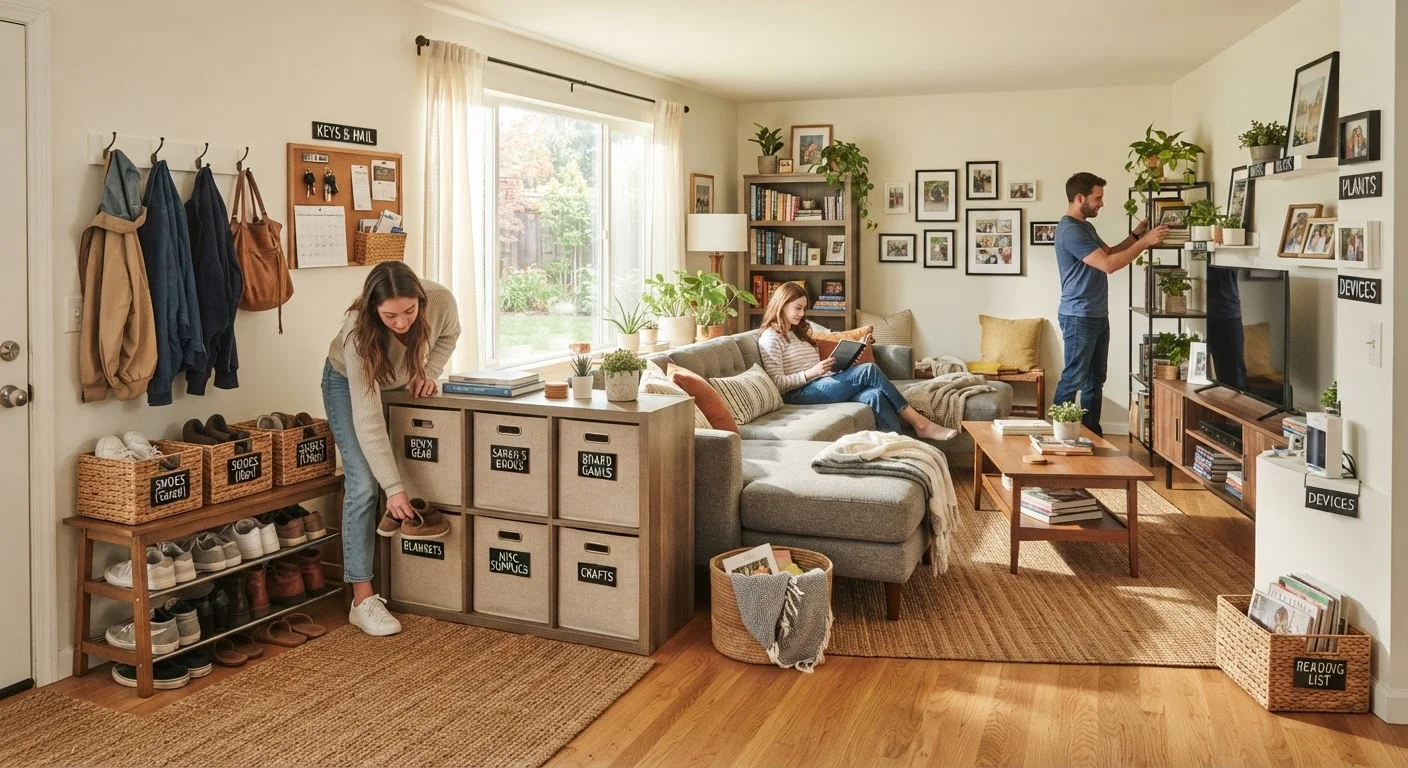
Your physical space actively shapes your behavior. When counters are already covered, one more item blends in easily. When there is no clear designated place for something, it lands wherever is convenient. Psychologists refer to this as environmental cuing - the way your surroundings trigger habitual actions without conscious thought.
Homes without a clear organizational structure inadvertently train residents to drop items anywhere. Over time, these small decisions harden into habits that feel automatic. This is also why organizing myths - like the idea that you need to do a total overhaul before any system will work - can make the problem worse. Read more in our article on organizing myths that keep your home messier.
Start With One Flat Surface
Rather than planning a whole-home overhaul, choose a single high-traffic surface - a kitchen counter, an entryway table - and commit to keeping it clear for one week. Small wins build the habit loops that eventually extend to the rest of your home. Consistency on a small scale is more sustainable than ambitious one-time purges.
Using Psychology to Build Smarter Habits
Once you understand the mechanisms driving clutter, you can design systems that work with your brain rather than against it. A few evidence-informed principles to consider:
- Reduce decisions at the point of entry. Designate a specific spot for incoming mail, bags, and shoes. When a place already exists, the decision is already made.
- Use the 'one in, one out' principle. When something new enters the home, something else leaves. This counters passive accumulation without requiring periodic overhauls.
- Separate emotional items from functional ones. Create a small, intentional space for sentimental objects so they don't quietly expand into every room.
- Work in short sessions. Decision fatigue is real - 20 focused minutes of sorting is more productive than a depleted two-hour marathon.
If the prospect of starting feels overwhelming, our guide on decluttering one room at a time offers a low-pressure framework for getting started without burning out.