Why Road Signs Still Trip Drivers Up
Most drivers pass their test, leave the theory knowledge behind, and rely on habit from then on. That works fine for everyday signs - but there are dozens of less common signs that regularly catch people out, even those who have been driving for years.
This guide breaks down the signs most commonly misunderstood on UK roads, explains what they actually mean, and clears up the most frequent mistakes. For a wider view of how road rules work day-to-day, see what the Highway Code means for everyday drivers.
| Total signs in the Highway Code | Over 100 distinct signs covered (UK Highway Code, DVSA) |
| National speed limit (single carriageway, car) | 60 mph (UK Highway Code) |
| National speed limit (dual carriageway/motorway, car) | 70 mph (UK Highway Code) |
| Stop sign legal requirement | Full stop mandatory, even if road appears clear (UK Highway Code Rule 172) |
| Red X lane closure enforcement | Fixed penalty and points apply for violations (UK traffic law, enforced via cameras on smart motorways) |
Signs Drivers Most Often Get Wrong
Here are the signs that generate the most confusion, along with plain explanations of what they mean:
National Speed Limit (white circle, black diagonal stripe)
Many drivers assume this means 70 mph on all roads. It doesn't. It means the national speed limit for that road type applies. On a single carriageway that's 60 mph for cars. On a dual carriageway or motorway it rises to 70 mph. The sign itself doesn't tell you which - you have to know your road type.
No Entry vs. No Through Road
A red circle with a white horizontal bar means No Entry - you cannot drive in at all. A blue rectangle with a red X and the words "No Through Road" is different: you can enter, but the road doesn't connect to another route. These two are often confused, sometimes with costly results.
Give Way vs. Stop
The Give Way sign (inverted red triangle) means slow down and yield if anything is coming, but you don't have to stop if the road is clear. The Stop sign (red octagon) requires a full, complete stop - even if nothing is approaching. Treating a Stop as a Give Way is a traffic offence.
End of Restriction Signs
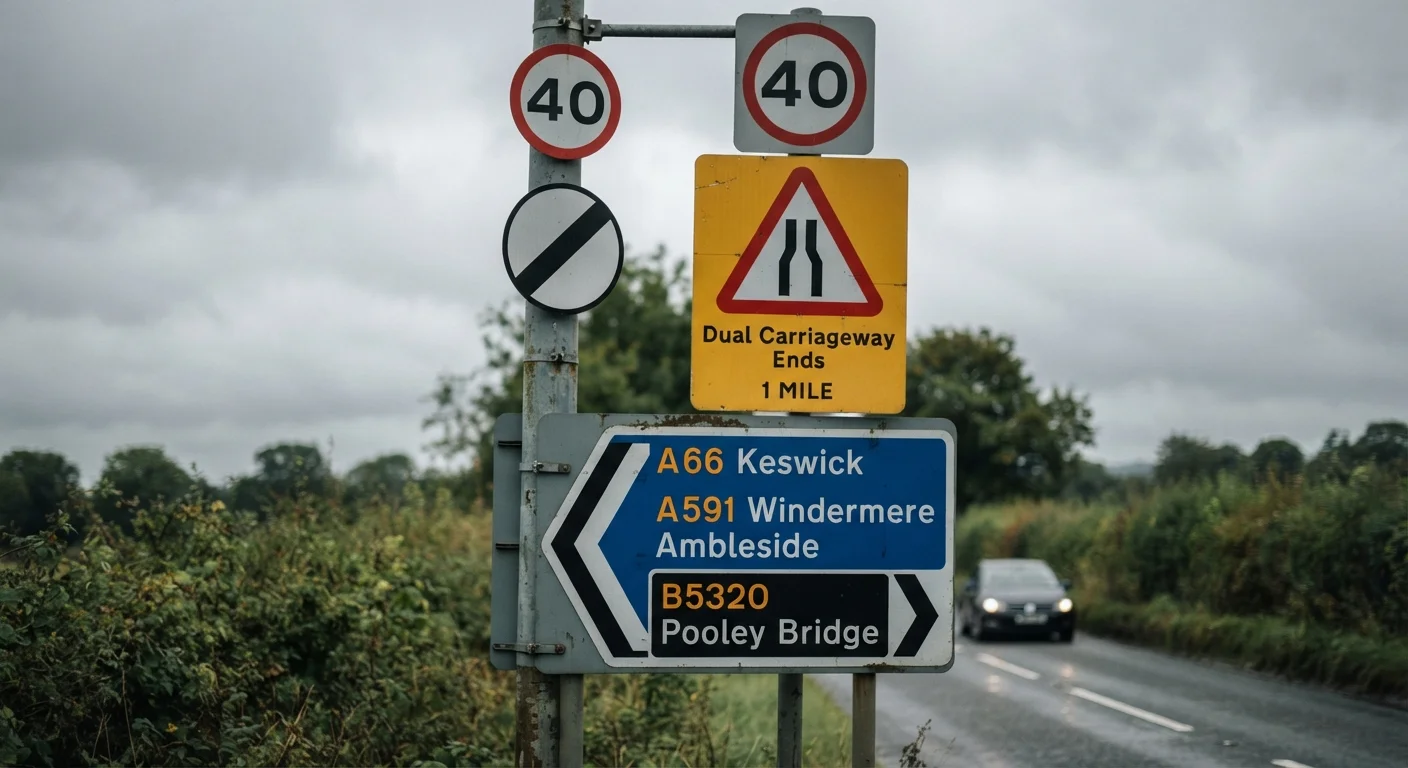
A white circle with a grey diagonal stripe ending a zone restriction - such as the end of a 20 mph zone - tells you the restriction is lifted. It does not mean speed up immediately; it simply means the national limit for that road type now applies again.
Weak Bridge Signs
A red-bordered rectangle showing a bridge icon and a weight - for example "7.5T" - means vehicles over that gross weight are prohibited. This catches out some van drivers who aren't sure of their vehicle's loaded weight.
National Speed Limit
The default maximum speed that applies when no other limit is signed. It varies by road type - 60 mph on single carriageways and 70 mph on dual carriageways and motorways for standard cars.
Give Way
A rule requiring a driver to slow down and yield to traffic on the priority road. Unlike a Stop sign, you don't have to come to a full halt if the way is clearly free.
Matrix Sign
An electronic overhead sign, common on motorways and major A-roads, used to display variable speed limits, lane closures, and warnings. Mandatory limits shown here carry the same legal weight as fixed signs.
Gross Vehicle Weight (GVW)
The total permitted weight of a vehicle including its load, passengers, and fuel. Relevant when approaching bridge weight restriction signs.
Regulatory Sign
A sign that gives a legal instruction drivers must follow - such as Stop, No Entry, or a mandatory speed limit. Ignoring a regulatory sign can result in a fixed penalty or prosecution.
Advisory Sign
A sign that recommends rather than legally requires a particular action - for example, an advisory speed shown without a red ring on a matrix gantry. These are not enforceable limits.
For guidance on navigating junctions and roundabouts where signs and road markings combine, see roundabouts, junctions, and right of way.
Motorway-Specific Signs Worth Knowing
Motorway signs follow a consistent pattern - blue backgrounds, white text - but a few cause confusion even among regular motorway users.
Red X Over a Lane
A red X on a matrix sign above a lane means that lane is closed. You must not drive in it. This is a legal requirement, not a suggestion - enforcement cameras are common on smart motorways.
Temporary Speed Limits on Matrix Signs
Illuminated speed limit signs on overhead gantries are mandatory limits while they're displayed. A blank gantry means the national speed limit applies. Many drivers treat amber advisory speeds (shown without a red ring) as optional - but ignoring mandatory gantry limits carries the same penalties as any other speed offence.
If motorway driving feels daunting, motorway driving for the first time covers lane discipline and speed awareness from the beginning.
Building Better Sign Awareness
Even experienced drivers can benefit from revisiting the Highway Code periodically - the full sign index is published there and is freely available from the government's official guidance pages. Misreading a sign is rarely deliberate, but it can result in a fixed penalty, points on a licence, or a collision.
If you notice habits creeping into your driving that you can't fully explain - including guessing at signs - it may be worth reviewing habits that quietly make drivers less safe. Small corrections early on are far easier than unlearning years of guesswork.
This article provides general information about UK road signs for educational purposes. Always refer to the current edition of the Highway Code and official DVSA guidance as the authoritative source for road sign meanings and driving law.