The Physics Behind a Rear-End Crash
When you're driving at 60 mph, your car is covering 88 feet every single second. That number matters because stopping a car isn't instant - it's a two-part process: first your brain recognises the hazard and sends a signal to your foot (reaction time), and then the brakes actually slow the car (braking distance).
Average human reaction time is roughly 1.5 seconds under normal conditions. That means before your brakes even engage, you've already travelled about 132 feet at 60 mph. Add the physical braking distance on top - which varies by vehicle, road surface, and tire condition - and total stopping distance can easily exceed 250 feet.
If the car in front of you fills most of your windshield, you almost certainly don't have 250 feet of clearance. That's the core of the tailgating problem: what feels like a manageable gap at a glance is, in stopping-distance terms, dangerously short.
~29%
Of all U.S. crashes involving rear-end collisions
According to the National Highway Traffic Safety Administration, rear-end crashes are one of the most frequent crash types on U.S. roads.
1.5 sec
Average driver reaction time before braking
Research on driver perception-reaction time consistently finds an average around 1.5 seconds - though fatigue, distraction, or age can push this significantly higher.
250+ ft
Estimated total stopping distance at 60 mph
The figure combines perception-reaction distance and braking distance under typical dry-road conditions; wet or worn surfaces increase this substantially.
For a deeper look at how speed changes these numbers, see our guide to speed limits and stopping distances.
Why Drivers Underestimate the Risk
Most people consider themselves above-average drivers - a statistical impossibility, but a genuinely common belief. This overconfidence extends to reaction time. Drivers often assume they can brake faster than average, when research consistently shows that real-world reaction times are longer than people expect, especially with surprise events.
There's also a sensory distortion at play. At high speeds, gaps look proportionally larger than they are because everything in your visual field is compressed. A two-second following distance at 70 mph is just over 200 feet - which looks like plenty of space, but provides almost no safety margin once reaction time is factored in.
“Drivers consistently overestimate how quickly they can stop and underestimate how little space they actually have. The gap between perceived safety and real safety is where most rear-end crashes happen.”
— Dr. David Strayer, Cognitive neuroscientist and distracted driving researcher, University of Utah
Tailgating can also become a habit so gradual that drivers stop noticing it. This is explored in our article on habits that quietly erode driving safety.
The Psychology: Why People Follow Too Closely
Tailgating isn't always about aggression, though road rage is a real factor. It's frequently driven by time pressure - drivers who are running late unconsciously close the gap, as if being closer to the car ahead will somehow speed up the journey. In practice, it doesn't. The vehicle in front is limited by the same traffic conditions.
Frustration with a slow-moving vehicle ahead is another trigger. Even when the leading driver is obeying speed limits, a following driver who wants to go faster may close the gap as a form of pressure - sometimes called intimidation tailgating. This is both dangerous and illegal.
Use a Fixed Marker to Check Your Gap
When following another vehicle, pick a stationary object - a signpost, bridge, or shadow line - and count how long after the car ahead passes it before you reach the same point. If you count to three before arriving, your gap is adequate for dry highway conditions. Make it a habit, and it becomes automatic within a few weeks of driving.
Understanding these psychological triggers is a key part of defensive driving - managing not just the road ahead, but your own responses to it.
Conditions That Make Tailgating Even More Hazardous
The three-second rule assumes dry pavement, good visibility, and alert drivers. Each of those conditions routinely fails in the real world.
- Wet or icy roads: Braking distance can increase by 50-100% or more on wet roads. A three-second gap in dry conditions may need to become five or six seconds in rain.
- Night driving: Reduced visibility means you may see a hazard later, cutting into the time available to react. Our article on night driving vs. daytime driving covers this in detail.
- Fatigue: Tired drivers have significantly slower reaction times. Fatigue and driving is a topic every driver should understand.
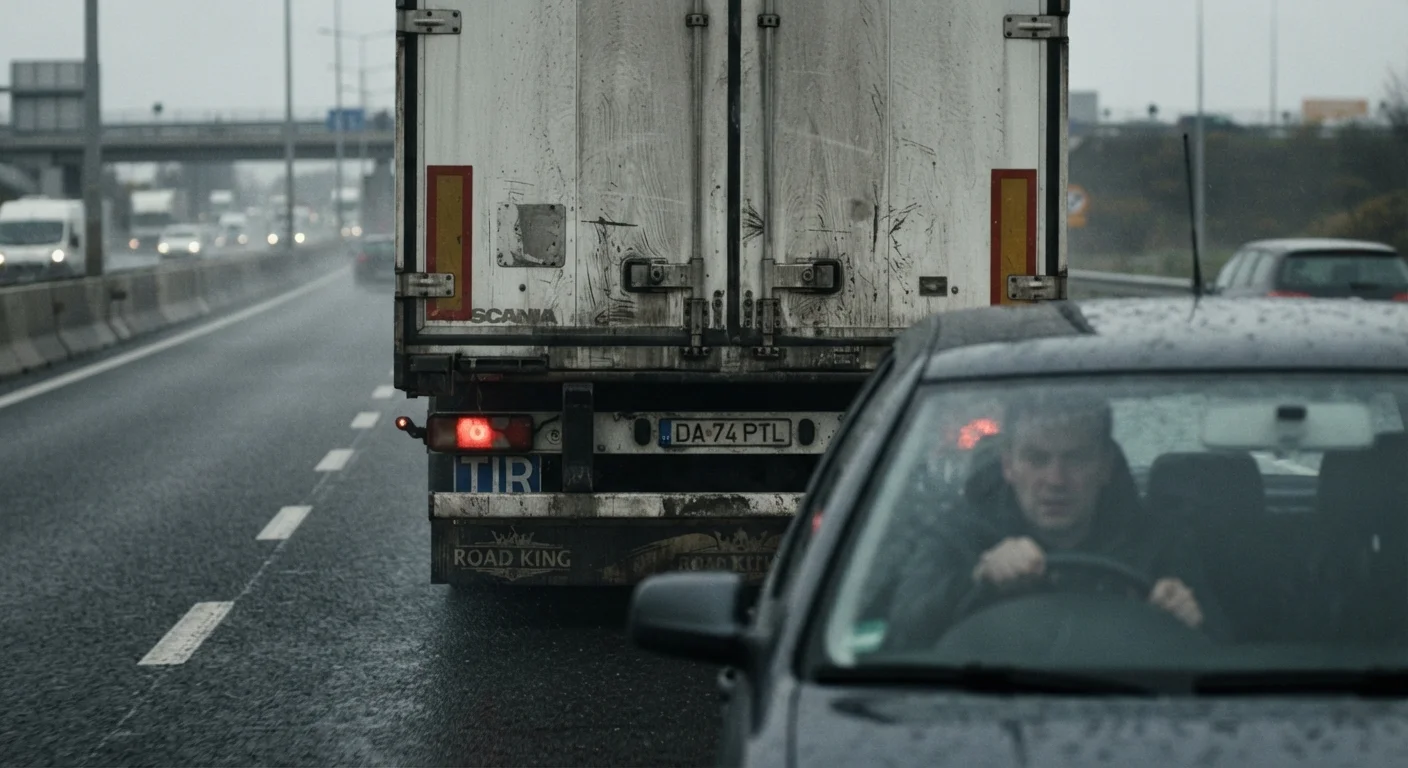
- Heavy vehicles: Following closely behind a truck means you lose visibility of the road ahead entirely - you're relying solely on the truck driver's decisions.
Conditions Change the Math Significantly
The three-second rule is designed for dry pavement and alert, rested drivers. In rain, fog, heavy traffic, or when fatigued, extend your following distance to at least four to six seconds. There is no penalty for leaving extra room - only for leaving too little.