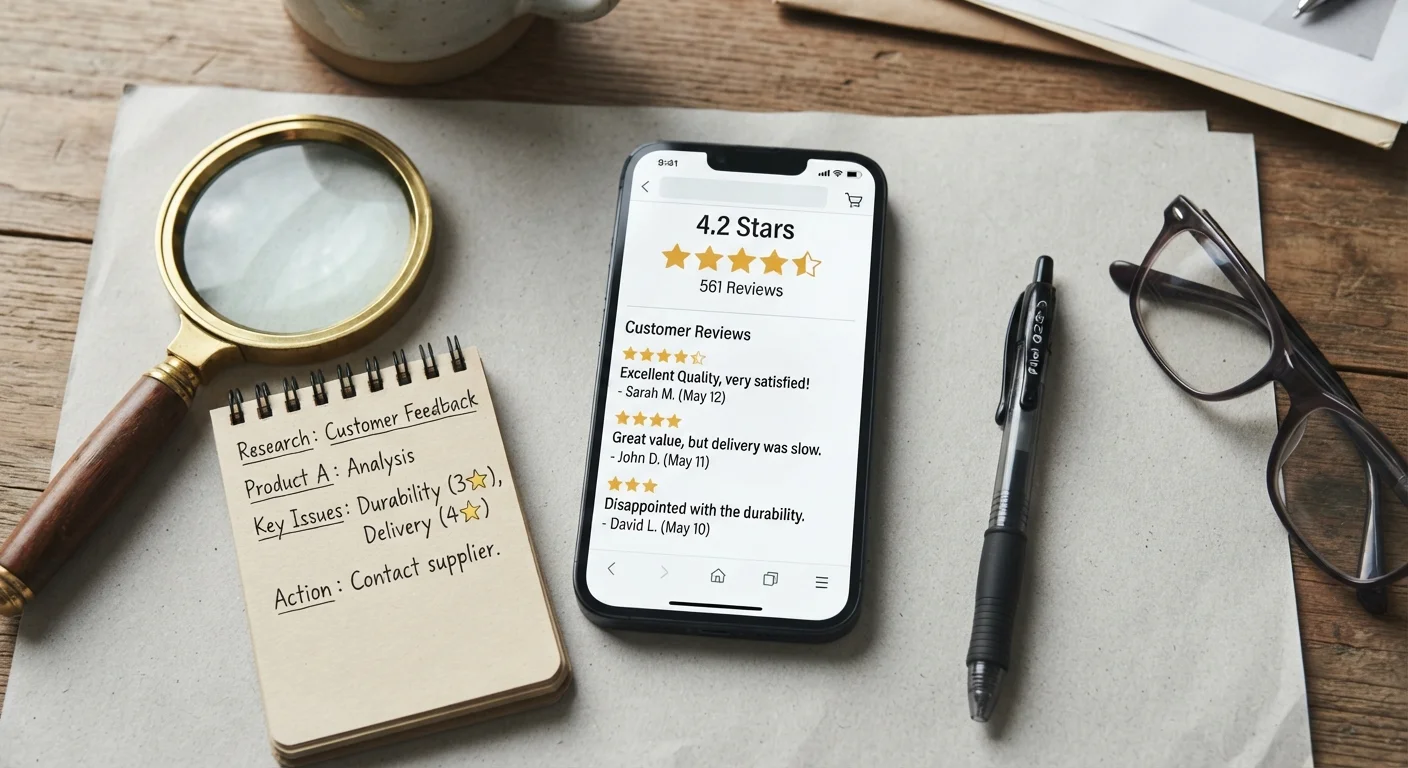
Not all reviews are built to compare fairly. These questions help you spot bias, missing context, and conditions that don't match your own situation.
Key Takeaways
Most reviews reflect the reviewer's specific situation, which may not match yours.
Undisclosed conflicts of interest can make a biased review look objective.
The testing conditions used in a review often determine whether its conclusions apply to you.
Star ratings and sample sizes can mislead as easily as they inform.
Asking a handful of pointed questions turns passive reading into active, critical evaluation.
Why Reviews Rarely Tell the Whole Story
A well-written review can feel authoritative. It has data, a clear verdict, and confident language. But confidence isn't the same as accuracy - and accuracy for one person isn't the same as relevance for you.
Reviews are always written from a particular vantage point: a specific budget, use case, expertise level, and set of priorities. When those factors go unstated, a review becomes harder to trust as a fair comparison - not because the writer is dishonest, but because the context is invisible.
This checklist gives you a structured way to pressure-test any review before you let it steer a decision. Run through these questions whenever you're weighing options side by side. For a broader framework on comparison thinking, see A Beginner's Framework for Comparing Anything.
Source & Conflict of Interest
Check whether the reviewer discloses any financial relationship with the brands being compared, including affiliate commissions, sponsorships, or free samples received.Must
Confirm the publication or platform has an editorial policy that separates advertising revenue from review outcomes.Should
Note whether the review covers all major options in a category or only a narrow selection that happens to favour one outcome.Should
Reviewer's Use Case vs. Yours
Identify what the reviewer says their primary use case is, and ask whether it matches yours in meaningful ways.Must
Check whether the reviewer's stated budget, experience level, or technical skill is similar to your own - conclusions drawn from an expert's perspective may not transfer to a beginner.Must
Look for mentions of the reviewer's environment or context (climate, living space, workflow) and assess whether those conditions apply to you.Should
Testing Conditions & Methodology
Confirm the review explains how each option was tested - vague phrases like 'we put it through its paces' without specifics are a flag.Must
Check whether the same tests were applied to every option being compared, or whether some received more thorough evaluation than others.Must
Note the date of testing: products, services, and markets change, and a review from more than a year or two ago may not reflect current versions or conditions.Should
Ask whether the review was based on a retail unit purchased independently or a pre-release or review unit provided by the manufacturer.Should
Sample Size & Breadth of Evidence
Determine whether the review reflects the experience of one person or draws on multiple testers, data points, or user surveys.Should
For user-generated review pools, check how many reviews underlie the aggregate score - a 4.8-star rating from 12 reviews warrants more scepticism than one from 1,200.Must
Look for evidence that the reviewer considered long-term performance, not just an initial impression after brief use.Nice to have
Criteria Weighting & Priorities
Identify which criteria the review weights most heavily (e.g. speed, durability, aesthetics) and ask whether those priorities match your own.Must
Check whether criteria important to you - such as accessibility features, repairability, or compatibility with existing equipment - are covered at all.Must
Notice whether the review's final verdict could change if its top-weighted criterion were swapped for a different one that matters more to you.Nice to have
Completeness & Missing Perspectives
Ask whether dissenting opinions or notable weaknesses are given equal space alongside positive findings - reviews that acknowledge trade-offs tend to be more trustworthy.Should
Check whether the review addresses how options perform for specific populations you belong to (e.g. left-handed users, renters vs. homeowners, users in a specific climate).Nice to have
Verify that the comparison includes the realistic total cost - not just the upfront price - such as ongoing fees, maintenance, or required accessories.Must
What to Do Once You've Audited a Review
Working through these questions won't always disqualify a review - often it simply helps you calibrate how much weight to give it. A review that scores well across these checks is genuinely more useful than one that doesn't, even if both are written with good intentions.
A Polished Format Isn't a Quality Signal
Professional-looking layouts, comparison tables, and confident star ratings can all appear in reviews that lack rigorous methodology. Visual credibility and editorial credibility are not the same thing. Always look for the substance behind the presentation - specifically, how testing was done and whether the reviewer's situation matches yours.
If a review raises multiple red flags - undisclosed relationships, mismatched use cases, a tiny sample size, or outdated testing conditions - treat it as one data point among many rather than a deciding input. Cross-reference with sources that test under conditions closer to your own situation.
You can also build on this process by creating a personal scorecard. Rather than relying on someone else's ranking, a scorecard lets you weight factors that actually matter to your life. See Building Your Own Comparison Scorecard for a step-by-step approach. And if you're concerned about whether reviews are genuine in the first place, Fake Reviews and How to Tell Them Apart covers the warning signs worth knowing.
Smart Shopping Editorial Team is the collective byline for our editorial team and contributor network. Articles published under this byline or an editorial pen name are researched, written, and reviewed according to our editorial standards for clarity, consistency, and independence before publication.
The content provided on our blog site traverses numerous categories, offering readers valuable and practical information. Readers can use the editorial team’s research and data to gain more insights into their topics of interest. However, they are requested not to treat the articles as conclusive. The website team cannot be held responsible for differences in data or inaccuracies found across other platforms. Please also note that the site might also miss out on various schemes and offers available that the readers may find more beneficial than the ones we cover.