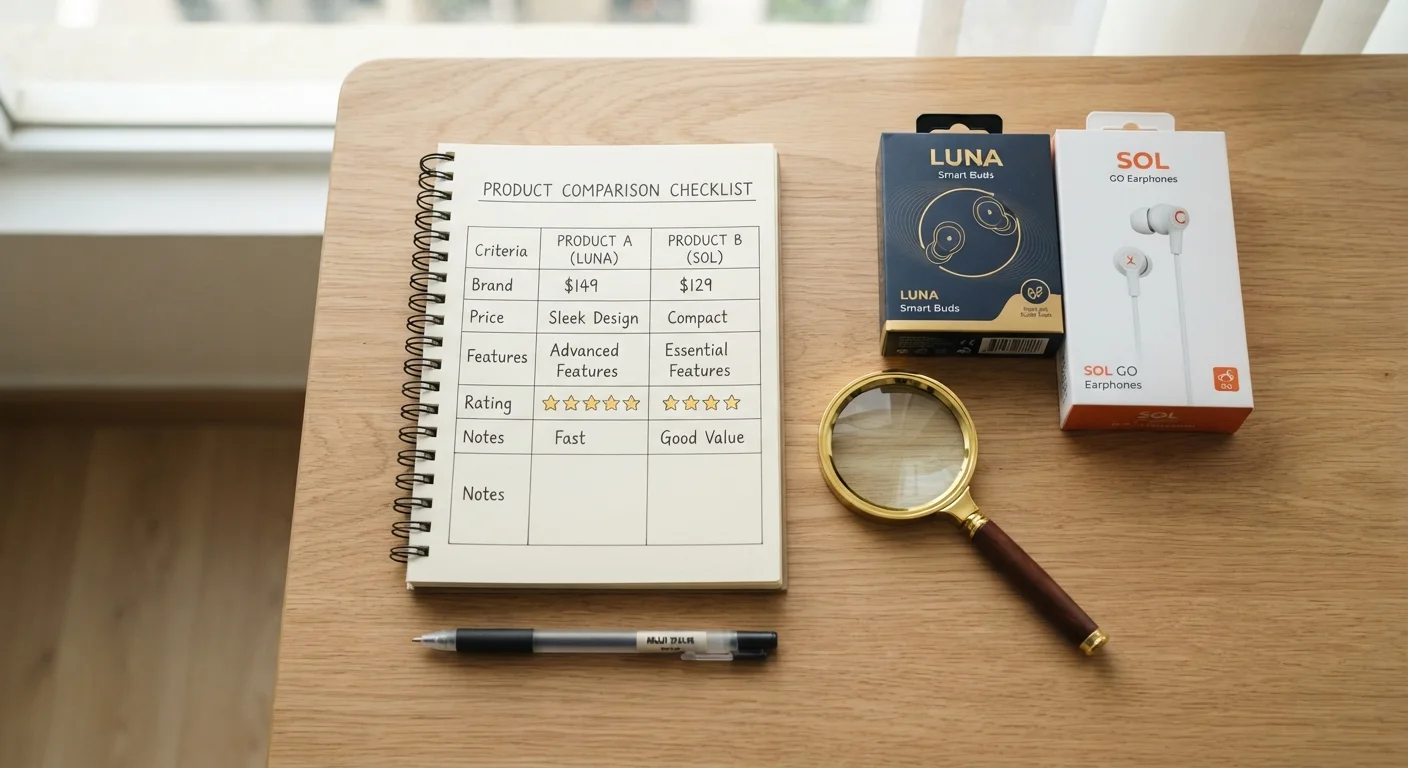

Why a Scorecard Beats a Generic Comparison Chart
Pre-built comparison charts are convenient, but they reflect someone else's priorities. A chart built for the average consumer may weight features you'll never use while burying the one specification that matters most in your situation. What a comparison chart actually tells you - and what it leaves out explores this blind spot in detail.
A personal scorecard flips the dynamic. You define the criteria, you assign their importance, and you do the scoring. The result is a structured decision that reflects your household budget, your physical space, your habits, and your tolerance for trade-offs - none of which a generic table can account for.
The method works across nearly any significant purchase: appliances, vehicles, software subscriptions, financial products, and beyond. If you're newer to structured comparisons altogether, our beginner's framework for comparing anything is a useful starting point before you build your first scorecard.
Spreadsheet app (e.g., Google Sheets or Excel)
Lays out criteria, weights, and scores in a grid that calculates totals automatically.
Pen and ruled paper
A manual alternative for building your scorecard without any software.
Product specification pages or brochures
Provides the raw facts you need to score each option accurately on each criterion.
How to Build and Use Your Scorecard
The process takes five steps and anywhere from 20 to 45 minutes, depending on how many options and criteria you're working with. Gather your materials first.
What you will need
List what actually matters to you
Before opening a spreadsheet, write a freehand list of every reason this purchase matters. Think in terms of your daily use: how often will you use it, where, with whom, and for how long? Aim for 8-12 raw criteria - you'll trim the list next.
Common categories to prompt your thinking: performance, durability, ease of use, physical size or fit, ongoing costs, customer support, and compatibility with things you already own.
Separate must-haves from nice-to-haves
Review your raw list and mark each item as either a must-have (a non-negotiable requirement) or a nice-to-have (a preference that would improve satisfaction but isn't essential). Any option that fails a must-have is eliminated before scoring begins - this keeps dealbreakers from getting lost in averages.
Aim for no more than three or four must-haves. If everything feels essential, push yourself to rank them; the exercise usually reveals that some requirements are genuinely more flexible than they first appeared.
Assign a weight to each nice-to-have criterion
Weight each remaining criterion on a scale of 1 to 5, where 5 means it strongly influences your satisfaction and 1 means it would be a minor bonus. The weights reflect relative importance - two criteria can share the same number.
Write your weights before you research options in detail. Looking at specific products first tends to inflate the weight of features that one option happens to have, a distortion covered in depth in our piece on cognitive biases that distort comparisons.
Score each option on every criterion
Create a grid: criteria down the left column, options across the top. For each cell, score how well that option meets that criterion on a scale of 1-10. Use publicly available specifications, verified user reviews, or hands-on experience where possible - not marketing copy.
Score all options on one criterion at a time rather than scoring one option completely before moving to the next. This reduces the halo effect, where a strong first impression inflates later scores.
Calculate weighted totals and read the result
For each option, multiply each criterion score by its weight, then sum all the results. The option with the highest total is the one that best matches your stated priorities - not necessarily the one with the most impressive feature list or the lowest price.
If the totals are very close (within 5-10% of each other), the scorecard is telling you the options are roughly equivalent for your needs. In that case, revisit your must-haves or let practical factors - availability, return policy, or timing - make the call.
For a structured final check before committing, see our decision-ready checklist for comparing options.
Your Priorities Must Come First
A scorecard only works if the criteria reflect your actual life - not review aggregates, influencer lists, or what someone else values. Before you add a single column, write down what would make this purchase genuinely useful for you. If you skip this step, you risk building a rigorous-looking tool that steers you toward the wrong option.
Don't Let Price Dominate Every Row
It's tempting to weight cost heavily across multiple criteria - affordability, value, and upfront price - which effectively triple-counts price and buries other factors. If budget is a constraint, set a hard maximum before scoring rather than letting price bleed into every row. Our article on why price-only comparisons backfire explains why this matters.
Keep Your Scorecard After You Decide
Save your completed scorecard - even a photo of a handwritten version - and revisit it six months after purchase. Comparing what you predicted against what you actually experienced sharpens your criteria-setting for every future decision. Over time, patterns emerge: you may discover that certain criteria you consistently overweight rarely affect your satisfaction.
Once you're comfortable with the format, the scorecard becomes faster to build with each use - and the criteria lists you develop for one purchase category often transfer directly to future purchases in the same area. Pair this habit with a pre-purchase checklist to make sure you're spending intentionally, not reactively, before any significant outlay.