Why the Same Checklist Won't Work for Both
When you buy a blender, you can read the specs, check the wattage, and inspect the build quality before money changes hands. The transaction is discrete - you pay, you receive, you own. Comparing two blenders is largely a matter of matching documented attributes against your needs.
Comparing two lawn care services, plumbers, or software subscriptions is a different exercise entirely. You're not acquiring an object - you're entering a relationship that will play out over weeks, months, or years. The quality of that relationship depends on factors no spec sheet captures: how a provider communicates when something goes wrong, whether their pricing stays consistent, and how painlessly you can exit if things don't work out.
A general comparison framework is a useful starting point, but recognising which type of purchase you're making helps you know which questions to prioritise.
What Products Ask You to Evaluate
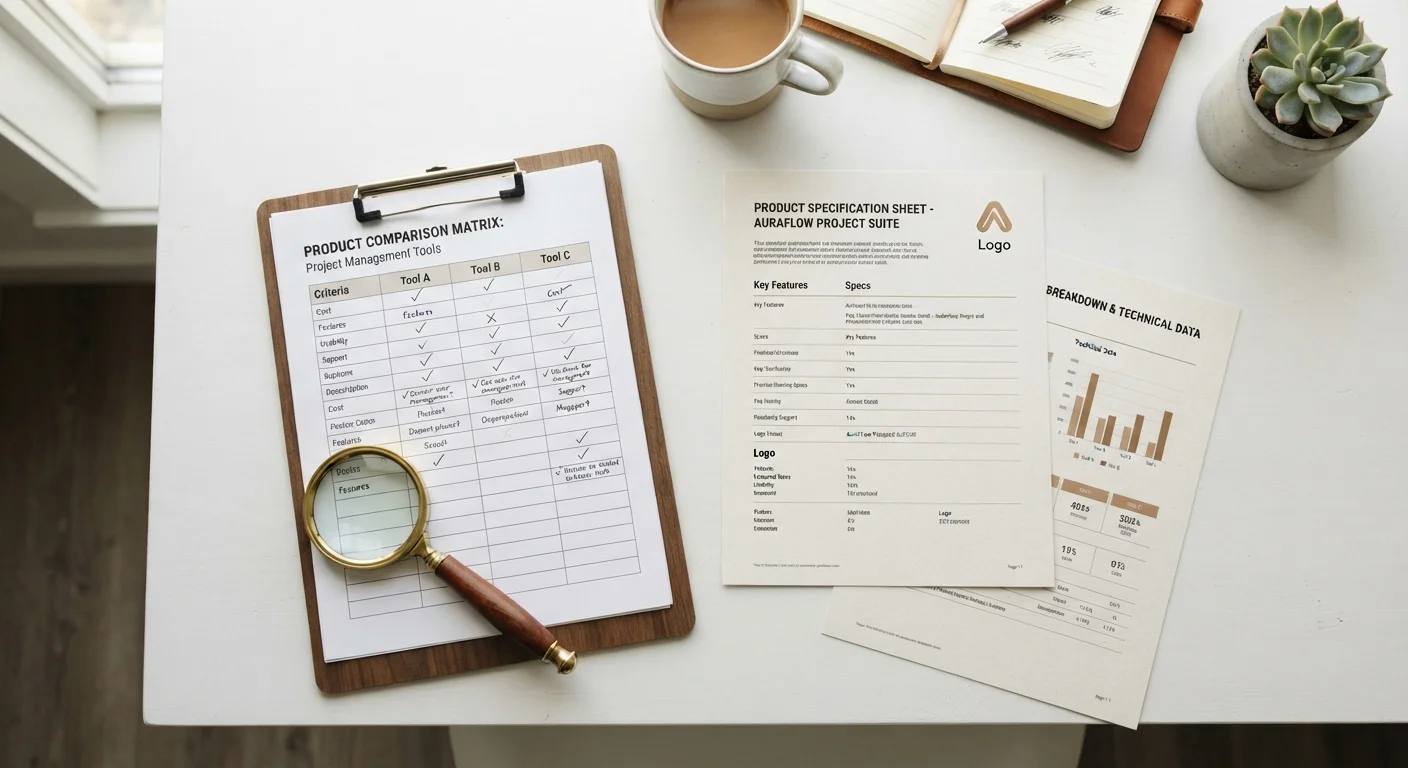
Product comparisons are largely objective exercises. The core criteria fall into a few reliable categories:
- Specifications and features - measurable attributes like dimensions, materials, power output, or compatibility
- Price and value - upfront cost weighed against expected lifespan and utility
- Warranty and return terms - what happens if the product fails early
- Availability - whether the item can be obtained when and where you need it
Most of these can be confirmed before purchase. Understanding product comparison terminology helps you decode spec sheets and feature matrices without guesswork.
One important caution: price is easy to measure, which makes it tempting to lean on too heavily. As comparing on price alone tends to backfire, especially when total cost of ownership - repairs, accessories, energy use - varies meaningfully between options.
| Evaluation Criterion | Physical Products | Services | |
|---|---|---|---|
| Primary evaluation timing | Before purchase (specs, reviews) | Ongoing - quality revealed over time | |
| Pricing transparency | Usually fixed and visible upfront | Often variable, estimated, or tiered | |
| Quality verification | Measurable via specs and testing | Requires track record or references | |
| Exit flexibility | Covered by return/warranty policy | Depends on contract and cancellation terms | |
| Reviews usefulness | Useful for performance and durability | Most useful for communication and reliability patterns | |
| Key risk | Product underperforms specs | Provider is inconsistent or hard to exit |
What Services Ask You to Evaluate
Service comparisons shift your attention from documented attributes to anticipated behaviour. The five most important evaluation areas are:
- Reliability and consistency - Does the provider deliver the same quality every time, or is performance unpredictable?
- Communication practices - How do they handle scheduling, delays, or disputes? This is almost impossible to judge from a website alone.
- Pricing structure - Is the quote a fixed price, an estimate, or a variable rate? Hidden fees are far more common in services than in product pricing.
- Contract and exit terms - Can you cancel without penalty? How much notice is required? Services that lock you in deserve extra scrutiny upfront.
- Accountability mechanisms - Are they licensed, insured, or certified where relevant? Who do you contact if work is substandard?
Ask for References Before Committing
For higher-stakes services - contractors, financial advisers, childcare providers - asking for two or three references is a reasonable and expected step. A provider who resists this request is signalling something worth noting. When you do follow up with references, ask specifically about how the provider handled a problem or delay, not just whether the work was satisfactory.
Reviews for services require a different reading approach than product reviews. Look for patterns in how providers respond to negative feedback - a provider who resolves complaints professionally is often more reliable than one with only glowing reviews and no visible accountability. See how to assess whether a review is a fair comparison before weighting any single source heavily.
The Overlap: Where Both Types Demand the Same Scrutiny
Despite their differences, services and products share some evaluation ground. After-sale support is one of them - and it's consistently underweighted by first-time buyers of both. Warranty and support terms often determine long-term satisfaction when two options otherwise appear equal.
Similarly, both types of decisions benefit from distinguishing genuine requirements from appealing extras. Separating needs from nice-to-haves applies whether you're weighing feature tiers in a software plan or deciding whether a premium cleaning service package includes anything you'll actually use.
~70%
Service complaints tied to communication failures
Consumer advocacy research consistently finds the majority of service dissatisfaction stems from poor communication, not technical quality of the work performed.
3-5x
Longer evaluation horizon for services vs. products
Consumer decision researchers note that service quality assessments typically require multiple interactions before a reliable pattern can be established.
The clearest practical takeaway: before you start comparing, identify which type of purchase you're making. That single distinction shapes which criteria deserve your time and which you can safely set aside.