Why Your Brain Works Against You at Comparison Time
Comparing options should be straightforward: gather the facts, weigh them, pick the winner. But human brains were not built for purely rational analysis. They rely on mental shortcuts - known as cognitive biases - that once helped us make fast decisions under uncertainty. In a marketplace flooded with choices, those same shortcuts get exploited, often without you noticing.
The result is that the option that feels superior after a comparison is not always the one that actually fits your needs best. Understanding the biases most active during comparisons is not about becoming a perfectly logical robot; it is about knowing where your judgment is most vulnerable so you can pause and recalibrate. See our beginner's framework for comparing anything for a structured process to apply once you have spotted these patterns.
Anchoring Bias
The first number you encounter in a comparison - a price, a rating, a spec - becomes a psychological anchor. Every figure you see afterward gets evaluated relative to that anchor, not on its own merits. A product priced at $180 feels like a deal when it sits next to a $300 option, even if $180 is objectively high for what you are getting.
To counter anchoring, try to establish your own reference point before you look at any options. Research what a reasonable price range or benchmark looks like for your category, so the first number you encounter does not automatically become the ruler by which everything else is measured.
The first price you see shapes every price that follows, regardless of actual value.
The Decoy Effect
Add a strategically inferior third option to any two-way comparison and you can make one of the original options look significantly more attractive - not because it improved, but because the decoy was designed to make it shine by contrast. This is a deliberate tactic in pricing structures across many industries.
A classic pattern: a small option at $5, a large option at $12, and a medium option at $10 that delivers almost as much as the large for slightly less. The medium exists to make the large look like obvious value. Recognising the decoy means asking: would I still choose this option if the third choice were removed entirely?
A well-placed third option can make a mediocre choice feel like the obvious winner.
Social Proof Bias
When an option has thousands of positive reviews or is labelled as a bestseller, it triggers a powerful instinct: if so many people chose this, it must be right. Social proof is not always misleading - popularity can reflect genuine quality - but it is a proxy, not proof. What works for a large, general audience may not work for your specific situation, budget, or priorities.
Our guide on making sense of user reviews goes deeper on how to extract signal from large review pools rather than simply being swayed by volume.
Popularity tells you what the crowd chose, not what fits your specific situation.
Framing Effect
The same information presented differently produces different reactions. A product described as having a 90% satisfaction rate feels more appealing than one described as having a 10% complaint rate - even though both statements carry identical information. In comparisons, framing appears in feature descriptions, spec labels, and marketing copy constantly.
Train yourself to flip the frame. When you read a positive statistic, ask what the negative version is. When a feature is described as an advantage, ask what the alternative looks like stated neutrally. This habit strips away presentation bias and lets you assess the underlying facts more clearly.
How information is presented shapes your reaction as much as the information itself.
Confirmation Bias
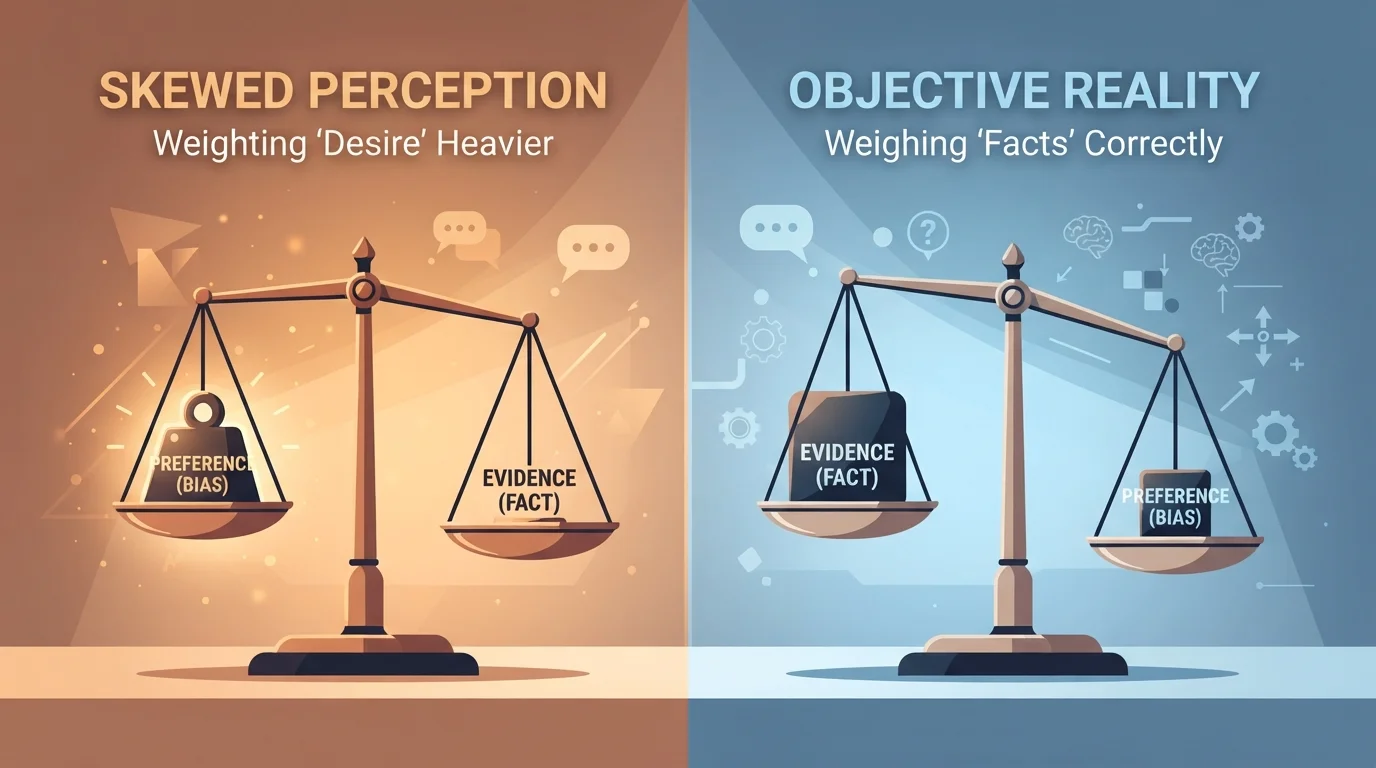
Once you lean toward an option - even slightly - your brain begins filtering incoming information to support that leaning. Evidence that confirms your early preference gets weighted heavily; evidence that challenges it gets dismissed or forgotten. During a comparison, this means the option you favoured after the first few data points tends to accumulate advantages even when the full picture is more mixed.
A practical countermeasure: before finalising your comparison, spend deliberate time making the strongest possible case for each option you are not currently favouring. This is not about changing your mind for its own sake - it is about ensuring your conclusion survives honest scrutiny. Questions worth asking before you treat any review as fair offers a useful checklist for this kind of structured second-look.
Once you lean toward an option, your brain quietly starts collecting evidence to justify it.
The Sunk Cost Fallacy
If you have invested time researching one option extensively, you may find yourself favouring it not because it is genuinely superior but because abandoning it feels like wasting all that effort. This is the sunk cost fallacy: letting past investment - of time, money, or energy - influence a forward-looking decision.
Time spent on research is gone whether you choose that option or not. The only question that matters is which choice serves your needs best going forward. If you notice yourself defending a pick primarily by citing how much research you did, that is a signal to reassess the comparison on its current merits alone.
Time spent researching an option is gone regardless - it should not tip the scales.
Putting This Into Practice
Knowing these biases exist is useful; catching them in real time is more useful still. Before committing to a comparison verdict, run a quick self-check: What was the first number or option you saw, and did it set a mental anchor? Is your preference driven by genuine fit or by the crowd? Did a third option appear just in time to make one choice look better by contrast?
Try the 'Blank Slate' Reset
When you feel close to a decision, write down your top two options on a blank sheet and list only what you know from memory - no re-reading marketing copy. What you recall tends to reflect genuine importance rather than presentation effects. If your reasoning holds up on the blank slate, your comparison is likely sound. If it falls apart, that is worth investigating before you commit.
Bias awareness also improves how you read outside sources. Reviews, comparison charts, and spec sheets can all be structured - intentionally or not - in ways that trigger these shortcuts. Our guide on what a comparison chart actually tells you covers the specific blind spots worth watching for. And if price is dominating your thinking, why comparing on price alone tends to backfire explains what cost-only comparisons routinely miss. For broader help avoiding poor purchases altogether, Avoiding Bad Buys is a practical starting point.
This article is for general informational and educational purposes only. It does not constitute financial, legal, or professional advice. Readers should consult a qualified professional for decisions specific to their own circumstances.