
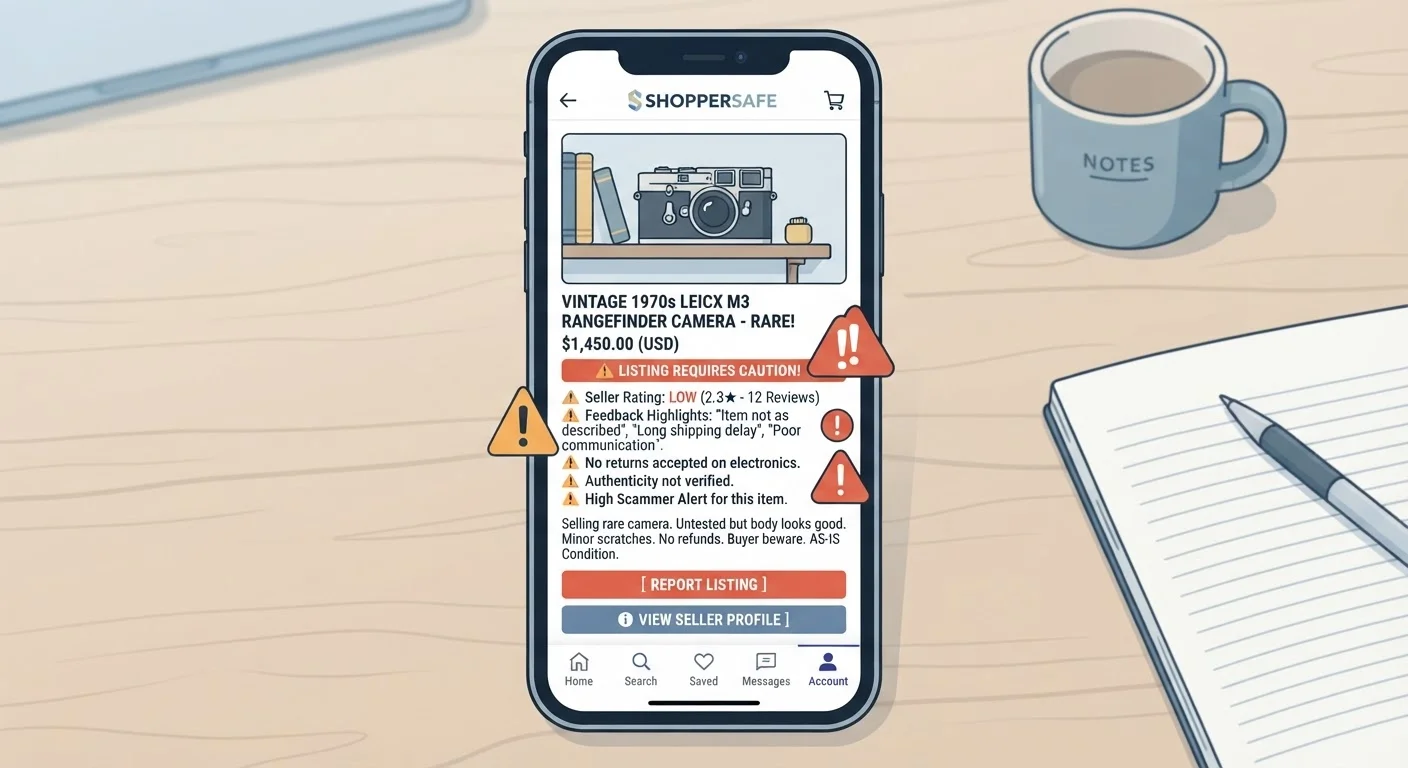
Why Marketplace Red Flags Matter
Online marketplaces make it easy to find almost anything - but they also make it easy for bad actors to set up shop alongside legitimate sellers. The platforms themselves cannot screen every listing in real time, which means the burden of spotting problems often falls on the shopper.
The good news is that most risky listings share a recognisable set of warning signs. Learning to spot them doesn't require technical expertise - it just takes a moment of deliberate attention before you hand over your payment details. The list below covers the most reliable signals that something may be off, drawing on patterns consumer protection agencies and fraud researchers consistently flag.
For a broader framework on evaluating sellers across both online and in-person contexts, see our guide to reading seller trustworthiness. And if you're also browsing used or refurbished items, buying second-hand safely walks through the extra checks that apply to pre-owned purchases.
A seller account created very recently
Most marketplaces display how long a seller has been active. An account opened days or weeks ago - especially one already listing dozens of products - deserves extra scrutiny. Legitimate new sellers do exist, but fraudsters frequently create fresh accounts to sidestep negative feedback accumulated on older ones. If the join date is recent and there are zero completed transactions, consider waiting until the seller has an established record or look for the same item from a longer-standing source.
Fraudsters often create fresh accounts to sidestep negative feedback from previous activity.
Only stock or manufacturer images - no original photos
A seller who cannot or will not provide their own photographs of the actual item they are shipping is a concern. Stock images and brand marketing photos tell you what a product is supposed to look like, not what the seller actually has in hand. This matters especially for electronics, collectibles, clothing, and second-hand goods. If a listing uses only polished manufacturer imagery and declines your request for original photos, treat that as a meaningful signal about what may arrive - or whether it will arrive at all.
Stock images tell you what a product should look like, not what the seller actually holds.
Prices that seem dramatically too low
A price that is substantially below what every other seller charges is not automatically a deal - it is frequently a flag. Common explanations include counterfeit goods, items described inaccurately, listings designed to collect payment before disappearing, or bait-and-switch tactics where a substitute inferior item ships instead. Use the going rate across multiple sellers as your reference point. If one listing is 50-70% cheaper than everything else, ask why before you buy, not after. Our comparing options hub covers how to evaluate price differences methodically.
A price far below market rate is more often a warning than a windfall.
Vague, missing, or copy-pasted product descriptions
Legitimate sellers typically know their inventory and describe it with specifics: dimensions, materials, condition, included accessories, compatibility notes. Listings padded with generic marketing language, copied verbatim from a manufacturer's page without any seller commentary, or conspicuously short on detail suggest either that the seller doesn't physically have the item or doesn't care whether it suits your needs. Vague descriptions also make dispute resolution harder if the item arrives and doesn't match your expectations. See build quality warning signs for what to watch for in item descriptions specifically.
Sellers who know their stock describe it with specifics - vagueness is rarely accidental.
A cluster of suspiciously uniform positive reviews
A handful of five-star reviews all posted within the same short period, using similar phrasing, with no detail about the purchase experience, is a well-documented pattern of review manipulation. Genuine feedback tends to be mixed in tone, specific about the product, and spread across time. Look for reviews that mention specific features or mention downsides - those tend to be more reliable signals of a real transaction. If nearly every review reads like promotional copy, weight that accordingly.
Genuine reviews are mixed, specific, and spread over time - uniform praise in a short window is a red flag.
No clear return policy or contact information
Reputable sellers make it easy to understand what happens if you need to return an item or raise a problem. When a listing lacks a return policy, links to a broken page, or provides no way to contact the seller directly, you are essentially agreeing upfront that disputes will be difficult. Before purchasing, confirm that the seller has responded to buyer questions previously, that a return window is stated explicitly, and that there is a clear method of contact beyond the platform's generic messaging tool.
If a return policy is absent or buried, assume disputes will be difficult by design.
Requests to pay or communicate outside the platform
This is one of the most serious red flags on any marketplace. When a seller asks you to move the conversation to a personal email, messaging app, or requests payment via wire transfer, gift cards, or cryptocurrency rather than the platform's checkout, they are asking you to abandon all buyer protections. Marketplace purchase protection, dispute resolution, and chargeback rights generally apply only to transactions completed through the platform's official payment system. There is almost no legitimate reason for an established seller to route payment elsewhere.
Paying outside the platform's checkout means surrendering all buyer protections - a risk rarely worth taking.
Build a Habit of Checking Before You Click
No single red flag guarantees a listing is fraudulent, but multiple warning signs appearing together should prompt you to walk away. The most effective approach is to treat each new seller as an unknown quantity until their track record, listing quality, and contact details give you genuine confidence.
When in doubt, search the seller's name
Before committing to a purchase from an unfamiliar seller, run their username or business name through a search engine. Scam forums, consumer complaint boards, and social media threads often surface warnings that won't appear on the marketplace itself. This takes about two minutes and can save you significant frustration.
If you want a structured routine to apply before finalising any purchase - marketplace or otherwise - our pre-purchase sanity check gives you a practical checklist. For additional help distinguishing real customer opinions from manufactured ones, spotting fake reviews is worth bookmarking alongside this guide.
This article is for general informational purposes only and does not constitute financial, legal, or consumer protection advice. If you believe you have been the victim of fraud, contact your payment provider and report the incident to the relevant consumer protection authority in your state or country.