
What the Comparison Trap Actually Looks Like
You sit down to research a purchase. You open a few tabs, then a few more. An hour later you have seventeen options bookmarked, three spreadsheets started, and no decision made. That's the comparison trap in action.
It doesn't feel like a trap at first. It feels like thoroughness. But there's a meaningful difference between gathering enough information to decide and gathering information indefinitely to avoid deciding. The trap kicks in when more research stops reducing uncertainty and starts creating it.
The mechanism is straightforward: every new option you add requires new comparisons against every option already in play. Five options mean ten pairwise comparisons. Ten options mean forty-five. The math compounds quickly, and so does the cognitive load.
Choice Overload Isn't the Same as Low Information
Having too many options is a different problem from having too little information. You can be well-informed and still be in the comparison trap if your option set is too large to evaluate consistently. Narrowing choices and gathering quality information are separate tasks - address them in that order.
Why More Options Can Lead to Worse Outcomes
Choice overload doesn't just slow you down - it can actively degrade the quality of your decision. When the mental load of evaluating options becomes too high, people often cope in predictable but unhelpful ways.
- Decision paralysis: You delay indefinitely, defaulting to the status quo even when a change would have served you better.
- Satisficing fatigue: You pick whatever option is in front of you just to end the stress - regardless of whether it actually fits your needs.
- Criteria drift: You unconsciously shift what you're looking for mid-comparison, making it impossible to evaluate options on a consistent basis.
- Phantom regret: Even after choosing well, awareness of all the alternatives you rejected increases post-purchase doubt.
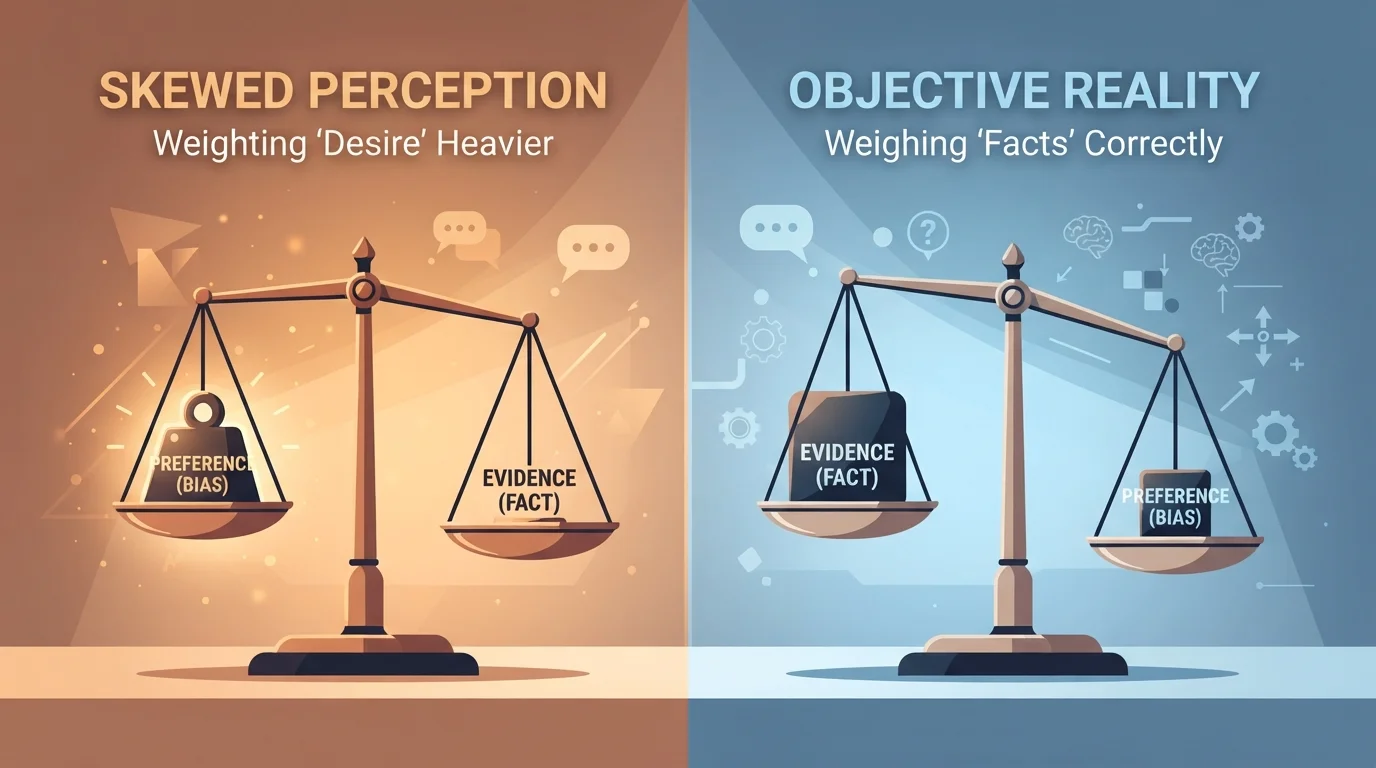
Cognitive biases make this worse. Anchoring, the decoy effect, and social proof can all distort which option feels superior when you're deep in a large comparison set.
67%
Shoppers report feeling overwhelmed by too many options
A survey conducted by Accenture found that a majority of consumers report feeling overwhelmed when faced with large product assortments, which can delay or prevent purchase decisions.
10x
Increase in pairwise comparisons from 5 to 10 options
Moving from 5 to 10 options multiplies the number of possible pairwise comparisons from 10 to 45 - illustrating why expanding the field exponentially increases cognitive load.
How to Narrow the Field Before You Compare
The most effective way to avoid the comparison trap is to reduce your option set before you begin detailed evaluation - not as a shortcut, but as a deliberate first step.
Set criteria first, then filter
Write down what a successful outcome actually requires. These are your must-haves: non-negotiable factors that any option must satisfy. Anything that doesn't meet all must-haves gets cut immediately, regardless of how appealing it looks on other dimensions. This alone typically reduces a field of twelve to three or four.
Time-box your research
Decide in advance how long you'll spend gathering information. When the time is up, evaluate only what's in front of you. More research time rarely yields proportionally better decisions - it mostly adds volume.
Use a structured comparison
Once you're down to a short list, a simple side-by-side review against your criteria keeps the evaluation honest. See our beginner's framework for comparing options for a repeatable process that works across most purchase decisions.
The Three-Option Rule as a Starting Point
If your initial search returns dozens of results, use filters to force the list down to no more than five before reading a single detailed review. Treating this as a hard constraint - not a guideline - removes the temptation to keep adding candidates 'just in case.' Three to five options is enough to make a well-reasoned choice in most consumer contexts.
When to Stop Comparing and Commit
There's no rule that says more research always improves outcomes. At some point - and often sooner than it feels - you have enough information. The signal to stop is when additional research is confirming what you already know rather than revealing anything new.
If you've defined your criteria, applied them consistently, and landed on an option that satisfies your must-haves, that's a defensible decision. It may not be perfect - no option ever is - but it's good enough to act on.
Worth noting: artificial urgency tactics like countdown timers can push you to decide too fast, while comparison overload pushes you to decide too slow. The goal is a middle path: deliberate but bounded research that ends in action.
For a structured way to confirm you've covered the essentials before committing, a decision-ready checklist can serve as a useful final check. And if you're relying heavily on comparison charts during your research, be aware of what those charts can and can't tell you before treating them as the final word.