
Why Comparison Jargon Trips Shoppers Up
Spec sheets, feature matrices, and comparison charts are designed to look helpful - and often are. But when you encounter terms like throughput, MSRP, or IP rating without context, a side-by-side comparison quickly becomes noise. Misreading a single spec can mean paying for capability you don't need or missing a limitation that matters a lot.
This reference guide decodes the terminology that appears most often when comparing products, so you can evaluate what you're actually looking at. For a repeatable process to structure any comparison, see our beginner's framework for comparing options.
Specification (Spec)
A measurable attribute of a product, such as weight, capacity, or speed. Specs allow direct numerical comparison between options but don't always reflect real-world performance.
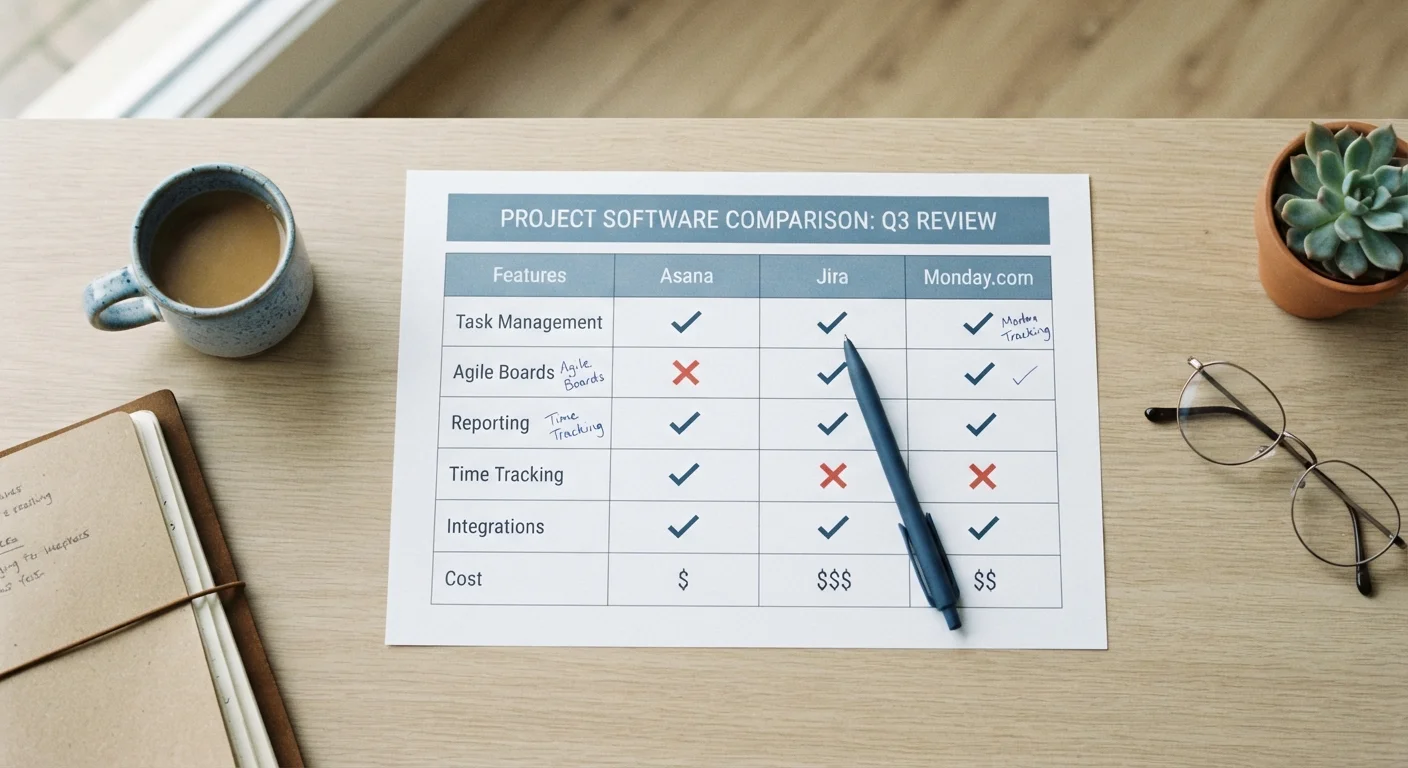
Feature matrix
A table that lists features across multiple products, typically using checkmarks or symbols to show which options include which capabilities. Useful for quick scanning but can oversimplify nuanced differences.
IP rating
Ingress Protection rating - a standard indicating how well a product resists dust and water. The two digits represent dust resistance (first) and water resistance (second); higher numbers mean greater protection.
Throughput
The volume of work or data a product can process in a given period. Common in networking, printing, and appliances. Higher throughput generally means faster real-world performance.
Compatibility
Whether a product works correctly with other devices, software, or systems you already own. Often listed in spec sheets as supported formats, operating systems, or connector types.
Latency
The delay between an input and a response. Lower latency is generally better in time-sensitive applications like audio, gaming peripherals, and wireless devices.
Form factor
The physical size, shape, and design layout of a product. Two products can have identical specs but different form factors, which affects whether they fit your space or use case.
TCO (Total Cost of Ownership)
The full cost of a product over its lifetime, including purchase price, ongoing supplies, maintenance, and eventual replacement. A useful metric for comparing options whose costs extend beyond the initial transaction.
Key Metrics and Specs Explained
Specs are the numbers and measurements manufacturers use to describe performance. Here's what the most common ones actually mean:
| Resolution | Number of pixels in a display (e.g., 1920×1080). Higher resolution means more detail, but diminishing returns apply at normal viewing distances. |
| Refresh rate | How many times per second a display updates its image, measured in Hz. Affects perceived smoothness of motion. |
| Battery capacity | Measured in mAh (milliamp-hours) or Wh (watt-hours). A higher number indicates more stored energy, but actual runtime depends on power draw. |
| RPM / Cycle speed | Revolutions per minute in motors or appliances. Indicates mechanical speed, not always actual cleaning or processing effectiveness. |
| Noise level (dB) | Sound output in decibels during operation. Useful for comparing appliances, fans, or tools where quiet operation matters. |
| Connectivity standard | The protocol a device uses to connect (e.g., Bluetooth 5.3, Wi-Fi 6). Affects speed, range, and compatibility with other devices. |
One thing spec sheets rarely disclose is how a measurement was obtained. Manufacturers may use favorable test conditions. A useful habit: check whether independent reviewers can reproduce the claimed numbers before treating them as reliable.
Comparison charts can make specs look definitive, but they have real blind spots - our article on what comparison charts actually tell you explains what typically gets left out.
Pricing and Value Terms You'll Encounter
Price labels carry their own vocabulary, and the differences matter:
- MSRP (Manufacturer's Suggested Retail Price): The price a manufacturer recommends retailers charge. Actual selling prices routinely differ - sometimes significantly.
- Street price: The real-world average price found across multiple retailers at a given time. More useful than MSRP for budgeting.
- Value proposition: The balance of features and price relative to alternatives. A product with a strong value proposition delivers meaningfully more (or the same) at a lower cost - or meaningfully better quality at a justifiable premium.
- TCO (Total Cost of Ownership): All costs associated with a product over its useful life - purchase price, consumables, maintenance, and eventual replacement. A lower sticker price doesn't always mean lower TCO.
- Depreciation: How quickly a product loses value over time. Relevant when resale matters to you.
Understanding certification claims on packaging is equally important - labels like "certified" or "approved" vary widely in what they actually guarantee. See our explainer on what certification labels really mean.
Support, Warranty, and Fine Print Terms
After-sale terms are easy to overlook during a comparison but often determine long-term satisfaction. Key terms:
- Limited warranty: Coverage that applies only under specific conditions - typically manufacturing defects. It does not cover accidental damage or normal wear unless stated.
- Extended warranty / protection plan: A separate, often purchasable agreement that extends or broadens coverage beyond the standard warranty. Terms vary widely.
- Restocking fee: A charge deducted from your refund when you return a product. Can range from a small percentage to 25% or more of the purchase price.
- Return window: The number of days after purchase in which a return is accepted. Shorter windows increase your risk if a problem surfaces late.
When two options look otherwise equal, warranty and support terms can tip the decision. Our guide on weighing warranty and support walks through how to factor these in systematically. And for the fine print on returns specifically, see return policies decoded.
This article is for general informational and educational purposes only. It does not constitute financial, legal, or purchasing advice tailored to your personal situation.